

While many of us were winding down to enjoy the Christmas period, Search had decidedly different plans, with the latter half of December bringing several major updates, including a progress check on AI Mode personalisation, and OpenAI planning the shape of ads in ChatGPT.
Updates are colour coded by importance:
🔴 Major developments likely to impact strategy
🟡 Worth watching or understanding
🟢 Informative - but lower impact for most
Search
🔴 December 2025 Google core update now complete
Google's December 2025 core algorithm update finished rolling out on the 29th. Finance and health websites saw the most ranking volatility, although Google reported that it was a standard update.
Interestingly, in some niches, bigger brands appeared to be just as vulnerable as smaller outfits, but there may be some correction as Google continues to launch smaller, unannounced updates.
You can get all the December 2025 core update details in our live guide to Google algorithm updates.
🔴 AI Mode personalisation is coming - but isn't ready yet
Google SVP Nick Fox has provided a progress update on AI Mode personalisation, reporting that it’s still being tested internally.
Announced at Google’s 2025 I/O event, this new capability would enable AI Mode to utilise a user’s past searches for even greater context when responding to a query. It would also allow users to opt into linking AI Mode with their Gmail account so information there can be also be used to contextualise queries.
For marketers…
In SEO terms, this suggests entity strength, branded demand and repeat engagement will gradually become more important visisbility factors. It may also be helpful to start planning content around contextual pairings, combining your core content ideas with entities potentially mentioned in a user's Gmail account.
A travel insurance business, for example, can infer that target audiences have travel booking confirmations in their Gmails. For the sake of the example, let's say that a user has a flight confirmation for Tokyo in their Gmail. They only type a rigid query like "travel insurance" into AI Mode, but If your brand is the authoritative "entity" for "Japan-specific travel coverage," Google’s AI can bridge that gap, surfacing your brand because your content matches the user’s unstated, baked-in context
But it’s worth noting that, as the Gmail integration will be opt-in, this shift won’t be universal and could be incredibly slow moving.
🔴 ChatGPT gets local knowledge panels
OpenAI has added local knowledge panels to ChatGPT. Unlike Google that will present local panels automatically, you have to click on a brand name in ChatGPT to open the side panel.
For businesses…
This should help to bring in qualified leads from ChatGPT. As you do for Google, it’s important to make your key business details prominent across your digital presence to ensure ChatGPT can find and use it to form your local panels.
🟡 Google adds 'Read more' links to SERP snippets
Google has rolled out small ‘Read more’ links for blue link listings on their SERPs. The link isn’t present for every search result, but for those that do have one, it’s positioned next to the snippet text.
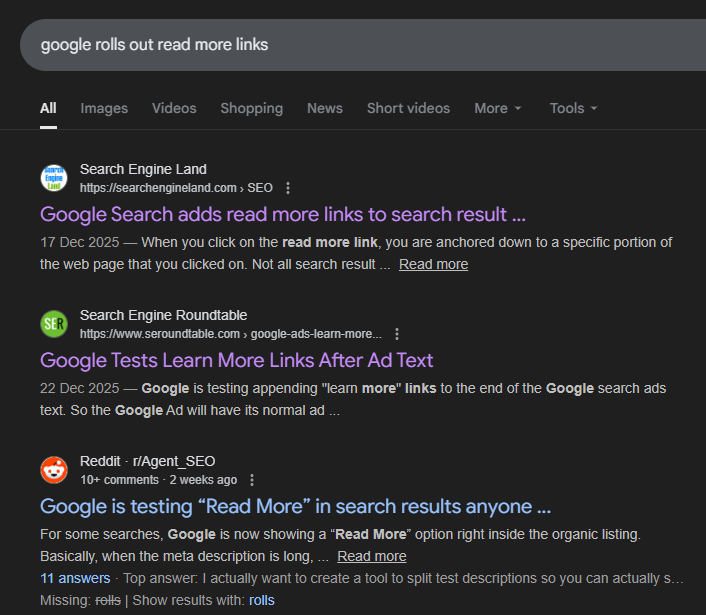
When clicked, the ‘Read more’ is anchored to the page text used in the snippet, jumping you directly to that information on the webpage - as opposed to the top of the page via the main blue link.
While Google hasn’t offered eligibility criteria for these new jump links, they typically appear when:
- There is a specific section of the page that answers the query more directly than the page in general.
- The search query is more complex and users are realistically looking for more information than can fit in the snippet areas.
For website owners…
This is unlikely to have a huge impact, but the ‘Read more’ link - though small - is quite noticeable for users reading snippets. It could therefore feasibly boost clicks.
To optimise for a jump link, address specific user intents. Make sure each section of your content answers a specific question or works towards a specific point. Google is looking for a concise fragment to “anchor to”.
If relevance to a query is spread thinly throughout your content, it’s unlikely your page listing will get the jump link. But if one section of your content is highly relevant, it significantly increases the chances that Google will serve your webpage with a jump link.
🟡 Search Live upgrade improves conversational faculties
Translation, language, audio and voice interaction upgrades to Gemini have extended benefits to Search Live, which now supports what Google describes as more ‘fluid and expressive conversations when you go Live with Search.”
In a nutshell, Search Live is now better at understanding and engaging with natural language.
For marketers…
The better Search Live gets, the more it will be used, increasing the value of being cited in a Live response.
Optimising for visibility in Live responses involves making content more understandable and extractable to Google’s AI systems.
🟢 Google can’t prepare publishers ahead of updates
Google’s John Muller explained that it’s not feasible for Google to pre-announce updates (core or otherwise) and give site owners a heads-up beforehand. According to Mueller, it wouldn’t be possible to give a specific time and date with any confidence, so announcing ahead of time is out of the question.
Arguably, Google could prime an update then hold fire to give site owners notice, but Mueller didn't comment on this. Presumably, as updates are designed to continuously resolve system issues, Google isn't willing to let these problems run on any longer than absolutely necessary. When seen in this light, giving site owners time to prepare for an update would activley harm the user experience.
For site owners…
This means a proactive, continuous strategy for improving SEO and website quality is and will remain essential to weathering Google updates.
You’ll never know ahead of time when an update is going to land, so you have to assume a resilient posture as standard.
Besides, some of the systems that shape the impact of updates, such as NavBoost, utilise data collected over a year+, so unless Google scheduled years in advance, you wouldn’t be able to fully turn the tide on a bad hit to come.
Website performance in decline following the December 2025 core update? We can help. Contact TDMP today to kickstart the recovery process.
🟢 Gemini Flash comes to AI Mode
On December 18, Google started rolling out Gemini Flash 3 for AI Mode, deepening AI Mode’s reasoning capabilities while maintaining the speed expected of traditional search.
SEO
🔴 Google updates JavaScript SEO documentation
Update #1 - Google warns not to rely on JavaScript to reverse Noindex
Google has updated its JavaScript SEO documentation, clarifying that if there’s a Noindex tag in your initial HTML, their crawlers may stop there, not bothering to run your JavaScript.
This means that if you’re using JavaScript to reverse the Noindex tag in your HTML, it may not trigger, resulting in the page being permanently excluded from search results even though your code eventually tells Google to index it.
For site owners and developers…
Any page you want to appear in search results should never contain a Noindex tag in the initial HTML (the source code Google crawls first). Do not rely on JavaScript to make it indexable after the fact, as Google may never reach that stage.
It’s a bit of a hurdle because there are several practical reasons for doing so, such as preventing partial indexing or handling API failures, but there are safer alternatives, including but not limited to:
- Server-Side Rendering (SSR): Make sure the server sends the actual content and the correct tags in the very first response.
- Proper HTTP Status Codes: If an API fails or content is missing, have the server return a 404 (Not Found) or 410 (Gone) immediately.
Update #2 – Google advises canonical HTML and JavaScript URLs match
Another addition to the documentation states that canonical URL injected via JavaScript must match the Canonical URL in your raw HTML. It goes as far as advising against setting canonical URLs via JavaScript at all, even though it is technically supported.
The problem is that Google searches for canonical signals twice, once for each crawl. The first crawl covers your raw HTML, while the second covers JavaScript elements.
Mismatches between canonicals create a conflicting signal for Google. When the raw HTML points to one version of a page but the JavaScript later changes it to another, Google is forced to guess which one is correct. This often leads to:
- Ranking the wrong page: Google may ignore your preferred URL and index a duplicate version instead.
- Delayed indexing: Because Google has to reconcile two different instructions, it may take much longer for your content to be properly processed.
- Unpredictable snippets: The search result for your page might fluctuate or show incorrect information.
For site owners and developers…
The safest approach is to ensure your server sends the correct canonical tag in the initial HTML response. If your site architecture requires JavaScript to handle the canonical, the official recommendation is to leave the canonical tag out of the initial HTML entirely.
This prevents Google from seeing two different instructions and ensures it only acts on the final, rendered signal.
🟡 Google reminds that sluggish site migrations are a bad idea
John Mueller explained during an online Q&A that Google’s systems expect a clear before-and-after state during a site migration. When migrations are handled gradually over an extended period, Google’s algorithms can have trouble determining which domain is the true representative of the site’s identity.
This isn’t new information for SEOs, but it’s a crucial concept for website owners to understand when planning a move.
For website owners…
Where possible, site migrations must be done swiftly to ensure Google has a clear understanding of what the site is now compared to what it was.
In terms of SEO, migrations can be troublesome at the best of times, so it’s crucial you don’t allow room for any additional complications.
That said, for large, complex sites, there are often valid practical benefits for a gradual migration, including easier troubleshooting and reduced server load.
The key, however, is still to wrap up a staggered transition as quickly as possible, thereby limiting the time Google’s systems are stuck working with conflicting inputs.
🟢 Google updates GBP verification support form
Google has updated the Google Business Profile verification issues support form to acknowledge the specific problems businesses face when attempting to verify their account.
Previously, guidance was limited and generic. Now, there are dedicated checkboxes to specific issues.
For businesses…
This should make life a lot easier for both you and Google. You can specify exactly what you're struggling with, and Google can offer highly relevant and effective support.
In short, communication channels here have become much more precise, therefore resolutions will arrive faster.
For support with GBP video verifications, see our guide: Google Business Profile video verification - full guide
Paid Media
🔴 OpenAI is actively discussing how to bring ads to ChatGPT
According to a report from The Information, OpenAI are getting serious about bringing ads to ChatGPT, revealing that several ideas are currently in consideration... some more inspired than others.
Despite Sam Altman’s claim earlier in the month that ad content in ChatGPT would differ from Google’s ad content, and that maintaining user trust would be the priority, one of the ideas is simply to give sponsored content preferential treatment in responses.
One of the more nuanced suggestions is to present the ad at a later stage of the conversation once the user is already headed in a certain direction and wants more information.
This approach could be beneficial to the user, the advertiser, and OpenAI, as the context provided increases the relevance of the ad served. User intent is met, clicks go up, and the trust remains (or even strengthens) between user and platform.
Another idea being thrown around OpenAI HQ is to simply place ads in a side panel.
For advertisers…
In our eyes, this is very early-stage planning, so there’s no need to start seriously considering ChatGPT as an ad platform yet. That said, here are some of our thoughts on the above revelations:
- If more than one ad format is adopted, advertisers should consider the difference in impact. Let’s say, for example, that both the late-conversation ads and side panel ads are approved. The former will likely be best where trust building is essential, while the latter would probably be a better fit for brand awareness or visual-led campaigns.
- Ads may need to be highly specific to solve a problem that has been defined over several back and forths between the user and ChatGPT.
- If ads are served later in a conversation, expect quite low impressions due to the specificity required and the fact that many interactions may not reach the ad-injection stage. That said, intent will be much higher, which should amount to impressive conversion rates.
- Altman and Co. are planning to preserve user trust, so expect ad vetting to be more intensive than on more traditional platforms like Google Ads.
🔴 Google adds 'Learn more' cards to ads on their SERPs
If you search for your own ad campaign, you may now see that Google has added “Learn more” summary cards you can click to see real time performance metrics, such as impressions and clicks. There’s also an option to edit topline aspects of your ad directly on the SERPs. Using this you can do things like adjusting headlines, descriptions, and URLs.
For advertisers…
While you’ll still need to dive into Google Ads to make major changes, this update allows you to make quick adjustments on the fly, resulting in swifter optimisations and a shorter timeline to optimal performance.
Need help maximising your return on ad spend? TDMP is an award-winning, Google Premier Partner PPC agency with an extensive track record of delviering exceptional results for clients big and small, even in highly regulated markets. Request a free PPC audit to get started.
🟡 Microsoft doubles PMax "theme" allowance
You can now enter 50 themes per PMax campaign on Microsoft Advertising, expanding upon the previous 25-theme limit.
Themes (or search themes) are words or phrases that describe what your customers are searching for. They’re optional signals you can attach to your Microsoft Advertising campaign (on top of keywords) to provide automated systems with a deeper contextual understanding of your audience.
Google Ads already allows 50 themes; this update brings Microsoft up to standard.
For advertisers…
This gives you more granular control over targeting as AI automatically optimises your ads and ad delivery dynamically, increasing the chances of reaching high value audiences.
It can also shorten volatile adjustment periods and give you a bit more flexibility to optimise for seasonality, allowing you to keep your core brand themes active while adding temporary themes that target specific times of year.
Additionally, more themes allow you to condense what would usually have to be split across multiple campaigns into a single campaign. For instance, complex product catalogues or businesses with varied service categories.
🟢 Microsoft prioritises Exact Match over Ad Rank
Ads Liaison at Microsoft Advertising, Navah Hopkins, clarified that exact match keywords are given absolute priority in the internal selection process.
If a user’s query perfectly aligns with your exact match keyword, Microsoft will prioritise that specific ad over your other campaign types, such as Performance Max or Broad Match Search, regardless of their respective Ad Ranks.
If there is no exact match found, the system reverts to Ad Rank (a combination of bid, relevance, and quality) to determine which ads appear and where.
For advertisers…
This ensures that your most important, high-converting keywords are served with the specific ad copy you wrote for them, rather than an auto-generated PMax ad.
However, in AI-driven conversational ad spaces like Copilot, exact matches are highly unlikely due to the potential for query variation. In these instances, PMax and Broad match are going to be served at a higher rate.
Security
🔴 WordPress plugin security vulnerability: Contact Form 7
A severe security vulnerability has been identified in the Redirection for Contact Form 7 add-on of the popular WordPress plugin Contact Form 7.
The add-on is currently live on over 300K websites. It’s primarily used to redirect site visitors to a specific website page after completing a form (think “Thank you” or confirmation pages), while compiling relevant information into a database.
But it’s been found to be vulnerable to attackers attempting to upload malicious files or even copy files from the server.
What makes this an 8.1 severity level vulnerability is that it’s an “unauthenticated vulnerability”. This means that a bad actor needn’t login or force their way into specific user privileges to launch an attack. Essentially, the door is left unlocked.
Thankfully though, in order for a malicious file to be uploaded, the ‘allow_url_fopen’ directive must be set to 'on', which is rarely the case, as shared hosting providers typically set it to 'off' to boost security.
For website owners…
While it’s important to announce unauthenticated vulnerabilities publicly so people can take action to protect their website, it also tips off bad actors, increasing the chances of an attack. So, if you use this add-on in your WordPress website, it’s crucial that you update to version 3.2.8 of the plugin or higher as soon as possible.
Stay current with TDMP
Search continues to move at a rapid pace, and as the race for AI search supremacy intensifies through 2026, disruption is inevitable, but so is opportunity.
If you're ready to get out of survival mode and into growth mode through expert SEO and PPC, contact TDMP today.