

With search companies eager to hit the ground running in 2026, January was incredibly busy for the industry, bringing a wide range of key developments, including big moves in agentic search, potential AI opt-out controls for site owners, and ads testing in ChatGPT!
Updates are colour coded by importance:
🔴 Major developments likely to impact strategy
🟡 Worth watching or understanding
🟢 Informative - but lower impact for most
🔴 Google explores opt-out controls for Search generative AI features
Google has announced it is exploring ways for websites to opt out of having their content used in Search generative AI features, including AI Overviews and AI Mode. This follows new requirements proposed by the Competition and Markets Authority (CMA).
Google said it is considering updates to its existing controls to give site owners more control over how their content appears in Search AI features, while avoiding changes that could fragment or disrupt the search experience.
The CMA’s proposals include measures around publisher controls, fair ranking, choice screens, and data portability. As part of this, publishers would be able to opt out of their content being used to power AI features, with greater transparency and attribution in AI-generated results.
For site owners and publishers…
More control over how content is used in AI-driven search experiences may be coming. Staying informed on how these opt-out mechanisms work will be important for managing visibility and content usage as AI features become more embedded in search.
Whether opting out is the right decision will depend on your priorities. From a marketing perspective, retaining visibility in AI-generated results is likely to remain important for most sites. While removing content from AI features could increase its perceived value and encourage direct visits, this approach would rely on users already being aware of the brand or publisher.
In practice, this means opting out may be more viable for well-known brands or publishers with strong direct audiences, whereas smaller or lesser-known sites could risk losing discoverability without a clear way for users to find them.
Barry Schwartz of SEO Roundtable ran a poll, finding 33% of respondents will block Google’s AI search experiences. 42% said they would not block Google, and the remaining 25% were unsure.
🔴 Google introduces Personal Intelligence in Gemini and AI Mode
Google rolled out Personal Intelligence in the Gemini app, followed by AI Mode. Personal Intelligence enables users to connect Google apps, like Gmail, Photos, YouTube, etc., to Gemini, so it can reason across multiple personal sources.
The feature is currently in beta and off by default. Users can choose which apps to connect, and it is initially available to U.S. Google AI Pro and AI Ultra subscribers on Web, Android, and iOS. Options to limit personalisation or provide feedback on responses are built in.
For users and content strategists…
Google is moving toward more integrated, context-aware AI experiences. Being cognisant of which data is connected and how answers are generated can help you understand and anticipate the role of personalisation in AI-assisted search results.
We discussed what optimisation for AI-generated results based on deep personal context might look like when we first covered it last month.
🟡 Google personalising AI Overviews and AI Mode by media preferences
In an interview on CNN’s Terms of Service podcast, Google’s Robby Stein shed some light on the type of personalisation Google is experimenting with in their AI-powered search results.
As an example, he offered, ‘So if you’re the kind of person that would always click a video, you might see video results higher.’
For website owners…
Personalisation for AI Overviews and AI Mode is in its early stages in the US, likely seen by Google as more of a test than a concrete feature. Still, the fact AI-generated results may rely on user media preferences to “rank” results means that rich media would only become a more important aspect of SEO and content strategy.
🟡 Google explains why AI Overviews don’t appear on every search
In a CNN interview, Robby Stein, VP of Product for Google Search, explained that the system measures user engagement and reduces or removes AI Overviews for queries where people don’t interact with them.
For example, searches for well-known individuals often don’t trigger AI Overviews because users tend to engage more with images, profiles, or social links. When AI summaries aren’t clicked or valued, Google’s system learns not to show them.
Stein also noted that Google sometimes expands queries “under the hood” to pull in related information, which helps explain why pages can appear in AI Overview citations even when they don’t match the exact wording of a query.
For site owners…
Fluctuations in AI Overview visibility may reflect user behaviour across query types rather than algorithm changes. Creating content that clearly answers broader or related questions may improve eligibility for AI Overviews, particularly for complex informational queries where these summaries are more likely to appear.
🟢 Apple chooses Google’s Gemini to power Apple Intelligence and Siri
After some back and forth between Google, OpenAI and even an Anthropic evaluation, Apple has chosen Google’s Gemini to power Apple Intelligence and it’s voice assistant Siri.
The contract reportedly outlines a ‘multi-year collaboration’ in which Google’s Gemini models and cloud infrastructure will serve as the basis on which Apple Foundation Models are developed.
For website owners…
Apple likely considered a multitude of factors when deciding which AI provider to partner with, but fundamentally, the goal is to improve their own product. With Gemini’s foundational support, expect Apple’s AI services to become much more capable of handling user requests, which, in turn, means websites visits may take another hit.
However, until agentic AI expands, business websites still have what AI can’t deliver… products and services. AI can answer questions, but it cannot solve practical, real-world problems, meaning your website is still essential, and that AI and voice search visibility should be a core thread in SEO strategies.
Microsoft
🟢 Bing homepage redesign promotes Copilot Search
For some users in the US, the Bing homepage now features a banner image (instead of full screen) with a prominent Copilot Search promotion beneath, reading:
‘Bing is your AI-powered search and answer engine’
Then beneath:
‘Introducing Copilot Search
‘Copilot Search in Bing gives you quick, summarised answers with cited sources and suggestions for further exploration, making it easier than ever to discover more.’
For marketers…
We’re not seeing this in the UK just yet, at least not broadly, but, just like Google’s omnipresent promotion of AI Mode, this will likely steer a proportion of users away from Bing’s traditional search results.
If your SEO strategy isn't at least AI-aware, you may not be as competitive in AI search results as you hope. Contact TDMP for support boosting online visibility across traditional and AI search.
SEO
🔴 AI Overviews are cannibalising Google Business Profiles
We covered the fact Google is serving Business Profile information in AI Overviews in mid 2024, but recently, it appears as if the “AI Local Packs” are becoming more common.
According to recent analysis, they’re appearing for roughly 8% of keywords, showing an upward trend.
For businesses…
This causes multiple different issues.
Firstly, GSC doesn’t attribute data from AI Local Packs to your Google Business Profile, which makes your GBP metrics unreliable. Secondly, AI Local packs sometimes suggest 1 or 2 businesses rather than the traditional 3, while recommending 32% fewer unique businesses. This makes local a more competitive prospect.
Then there’s the fact that AI Overviews doesn’t serve businesses with engagement options like a call button, making customer contact less likely.
Unfortunately, there’s currently no way to stop AI Overviews cannibalising your Business Profile, and even if there was, you’d be losing valuable visibility to competitors. This is why we still highly recommend keeping your GBP updated and optimised.
What you can do to maintain your lead levels is invest in Google Ads; sponsored listings retain the call option and position in AI Local Packs that organic listings no longer have. This is where TDMP can help.
We’re a Google Premier Partner PPC agency with a proven track record of delivering innovative locally-focused paid media campaigns that produce exceptional results for clients. Request a free PPC audit to get started.
🟢 Google adds Gemini integration to Trends Explore
Google has updated the Trends Explore page to include Gemini, helping users discover new search terms and automatically compare them. The redesigned page features a side panel that identifies relevant trends for your area of interest and suggests Gemini prompts for further exploration.
The update is rolling out gradually, so it may not be visible to all users yet.
For content creators and researchers…
This change makes it easier to identify emerging topics and compare search trends without manual effort. Reviewing suggested prompts and automated comparisons can help you stay informed about what’s gaining attention in your niche.
🟢 Similarweb shows shifting traffic share among AI chatbots
ChatGPT accounted for 64% of worldwide traffic share among generative AI chatbot websites in January, according to Similarweb’s Global AI Tracker. Google’s Gemini reached 21%, continuing a year-over-year increase. The data measures direct web visits at the domain level and does not include API usage, apps, or embedded assistants.
A year ago, ChatGPT held an estimated 86% share, while Gemini was at 5%, indicating a redistribution of direct web traffic rather than overall category growth. Other tools remain much smaller by this measure, each accounting for under 5% of visits.
Similarweb also noted seasonal effects during the winter break, with overall visits dipping across AI tools, and declines in traffic to specialist writing tools, while developer-focused tools showed mixed results. Traditional search traffic appeared relatively flat year over year in this dataset.
For marketers and site owners…
This data offers a snapshot of where direct, web-based attention is concentrating, rather than a full view of AI usage. It can be useful for understanding which assistants to monitor for visibility and referrals, but your own analytics will provide a clearer picture of how audiences are actually discovering and engaging with your brand.
Paid Media
🔴 OpenAI are now testing ads in ChatGPT
We’ve covered a very linear progression from OpenAI these past few months:
- Sam Altman revealing that ads will be coming to ChatGPT at some point (November 2025);
- OpenAI discussing which ad formats could work in ChatGPT (December 2025);
- And now, ads are live and being tested.
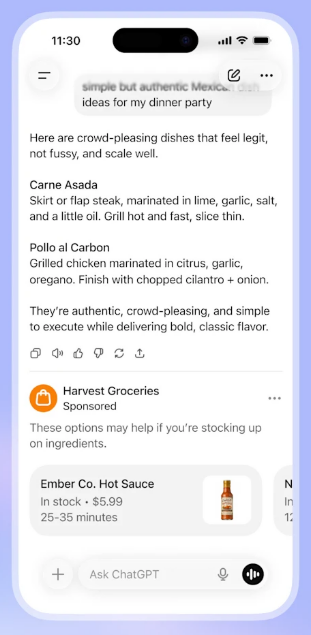
Altman and co. have settled on (for the time being, anyway) placing contextually relevant ads beneath the conversation, as opposed to embedding them within the chat itself.
Source: OpenAI
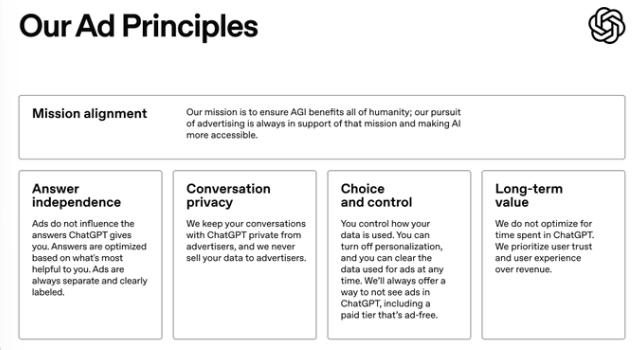
OpenAI has reported that ChatGPT responses will in no way be influenced by ads, a move to maintain user trust, which the company sees as vital. It’s also been made clear that ads will only appear in free accounts and ChatGPT Go subscriptions.
Source: OpenAI
They’ve chosen to use an impression-based payment model rather than click-based, which is an odd choice, especially if you’re trying to instil confidence in early investors. It’s also been reported that OpenAI is seeking roughly $60 per 1000 impressions, which isn’t cheap.
For advertisers…
This is objectively the best format that the OpenAI team were discussing in December 2025, as it leverages the deep context of the conversation to improve ad relevance, increasing the chances of engagement.
However, the current pricing model and cost will be prohibitive for many businesses. And
despite the relatively low-friction format, some users may react negatively to seeing ads in ChatGPT at first. This means early advertisers could face short-term brand perception challenges until ads in the platform become more familiar and accepted.
Once normalised, there could be some real potential here, but only if it makes sense for your business to advertise on the platform. For instance, your target audience may not use ChatGPT or perhaps use it for tasks that are irrelevant to your offerings. You can find out if this is the case in our guides:
- Who is using ChatGPT?: A demographic exploration
- How are people using ChatGPT: Applications, behaviours, and opportunities
It’s also worth noting that, as the middle and higher tier subscriptions remain ad-free, B2B advertising is less promising on ChatGPT. If you’re trying to get your solutions seen by key company decision-makers, chances are they’re using a paid account and won’t be reachable.
🔴 Google expands AI Mode ad formats and launches Universal Commerce Protocol
Google announced Direct Offers Ads, a new AI Mode ad format for guides and articles, branded AI agents, and a new open standard for agentic commerce called Universal Commerce Protocol (UCP).
Direct Offers Ads allow retailers to present promotions, such as discounts, to shoppers ready to buy, with AI deciding when an offer is relevant. They work alongside Performance Max and Standard Shopping campaigns and rely on verified Merchant Center promo codes.
In addition, a new AI Mode format for guides and article ads has been spotted, showing ads related to the user’s query for relevant content, suggesting Google is testing more diverse ad placements within AI-driven results.
UCP is an open standard that allows AI agents to interact with ecommerce stores across the shopping journey, supporting AI-driven checkout on eligible product listings in Search and the Gemini app.
For advertisers and site owners…
Ensuring your product data, promotions, and content are accurate and well-structured can help your listings and guides appear as intended as AI-driven ad formats and commerce features continue to evolve.
🟡 Google Ads launches asset comparison experiments for Performance Max campaigns
Google Ads has introduced a new experiment feature for Performance Max campaigns that lets you A/B-test assets. This allows you to compare the performance of two different sets of assets within the same asset group to determine which creative combination performs best.
When you set up an asset comparison test:
- Control group (Assets A): Your existing assets used as a reference for comparison.
- Treatment group (Assets B): Assets to test against the control group, which can include new or existing assets.
- Common assets: Assets not assigned to either group will continue serving normally to 100% of your campaign traffic.
For advertisers…
This feature gives you a more granular way to optimise Performance Max campaigns by identifying which combinations of creative assets drive the best results. If you’re running these campaigns, consider testing variations systematically to improve overall campaign performance without disrupting traffic from your existing assets.
🟡 Google Ads opens Campaign total budgets as an open beta
Google Ads has officially launched Campaign total budgets as an open beta for all advertisers. The feature is now available for Search, Performance Max, and Shopping campaigns and allows advertisers to set a fixed budget over a defined time period, from a few days up to 90 days.
Campaign total budgets are designed for short-term promotions or seasonal activity. Google automatically adjusts daily spend based on demand to aim to fully use the budget by the campaign end date, without requiring daily manual adjustments.
For advertisers…
This provides an alternative to average daily budgets when spend needs to be controlled over a specific timeframe. If you run time-bound campaigns, campaign total budgets may offer more predictable pacing, while average daily budgets remain better suited to always-on activity with flexible spend.
🟡 Microsoft Advertising announces multiple updates across campaigns and targeting
Microsoft Advertising announced a range of new features and updates across its platform, covering campaign goals, reporting, asset management, and targeting.
Key updates include:
- New customer acquisition goals now available as an open beta for advertisers using purchase goals.
- Share of voice (SOV) metrics, including impression share, click share, and impression share lost to budget or rank.
- Asset group-level URL options and tracking templates for Performance Max, allowing more granular tracking at the asset group level.
- Increased Search Theme limit, with Performance Max campaigns now supporting up to 50 search themes.
- Enhanced asset group import, allowing partial imports when some assets don’t meet requirements.
- Content targeting now generally available, including placement and topic targeting.
- Location targeting improvements aimed at smoother and more accurate setup.
- Autogenerated assets in Responsive Search Ads, enabled by default for new RSAs globally (excluding China and South Korea).
For advertisers…
These updates provide more flexibility in campaign setup, tracking, and targeting. Reviewing new metrics and controls (particularly SOV reporting and asset group-level tracking) may help improve visibility into performance and inform optimisation decisions.
🟢 Poll suggests growing interest in Microsoft Advertising for 2026
Navah Hopkins, Microsoft Advertising’s Ads Liaison, shared a LinkedIn poll asking whether marketers plan to include Microsoft Advertising in their marketing mix for 2026. The poll received over 200 responses.
Results showed:
- 42% said Microsoft Advertising is already part of their mix
- 36% said they plan to add it in 2026
- 23% said they do not plan to include it
While the results should be viewed with some caution due to potential audience bias, they do suggest increasing consideration of Microsoft Advertising among marketers.
For advertisers…
Microsoft Advertising continues to gain attention as part of a broader paid media strategy. Reviewing performance, audience fit, and incremental value may help determine whether it deserves a place in your 2026 plans.
As a general guide, Microsoft Ads are typically more cost-effective than Google’s, making it a great option for lower budget campaigns, but Google’s market is much larger, granting better reach. Combining the two gives you the best of both worlds. Read our dedicated guide for a more detailed comparison.
If you’re considering bringing Microsoft Ads into your paid media strategy, our PPC team can make sure your campaign generates valuable, actionable data efficiently, shrinking initial calibration periods and maximising your ROAS. Learn more about our PPC services.
🟢 Google details new AI model improving Google Ads fraud detection
Google published a research paper outlining a new AI model used to detect fraud and policy violations in Google Ads. The model, called ALF (Advertiser Large Foundation Model), was published on December 31, 2025, and is already deployed in production.
According to Google, ALF improves fraud detection rates by over 40 percentage points on one critical policy and achieves up to 99.8% precision on another. The model analyses a combination of signals (including ad text, images, video, landing pages, account history, and billing-related data) to better understand advertiser behaviour and intent.
Unlike previous systems, ALF can evaluate large volumes of diverse data together and compare advertisers in batches to identify unusual or suspicious patterns, while stripping out personally identifiable information before processing.
For advertisers…
This suggests Google is becoming more effective at identifying fraudulent or policy-violating behaviour at scale. While legitimate advertisers shouldn’t need to take action, it reinforces the importance of maintaining consistent account signals, compliant creative, and transparent billing practices as enforcement becomes more sophisticated.
Agentic Search
🟡 Microsoft and Google announce new agentic features
Microsoft
Microsoft has announced two agentic AI features. Copilot Checkout lets you make purchase within conversations with Copilot, and Brand Agents is essentially just an ecommerce chatbot that can be trained on your product data. It serves as an on-site sales associate that helps users find what they need.
These follow similar moves from both Google and OpenAI, who began launching agentic features for Gemini and ChatGPT respectively in Q4 of 2025.
This is a US-only launch for in-chat purchases (Copilot Checkout), though UK-based Shopify merchants can now apply for the waitlist to trial Brand Agents on their own websites.
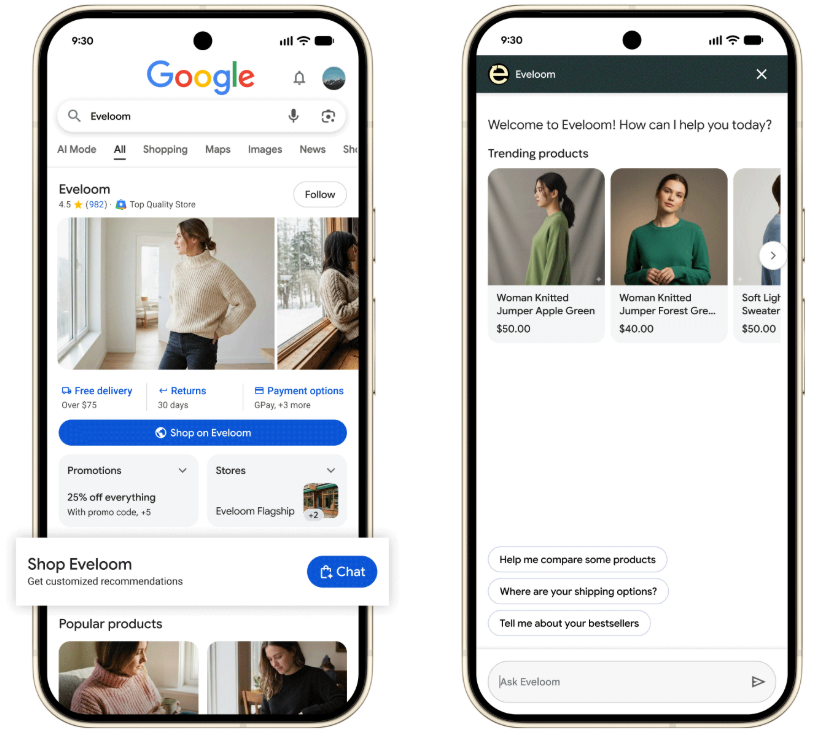
Google’s latest foray into agentic AI is “Business Agent”, which is very similar to Microsoft’s Brand Agents, but moves the option to start the conversation from your website to within Google’s search results when your brand appears.
This is currently just for US businesses with a verified Google Merchant Centre account, a claimed brand profile, and at least 50 approved offers.
Source: Google
For site owners…
We’ve covered agentic AI several times in these roundups, discussing how it’s likely going to become a significant part of search as the technology develops and consumer expectations evolve.
On the brand side of agentic AI, chatbots like Brand Agents and Business Agent may well improve customer experience when implemented thoughtfully.
On the user side, it’s creating a bigger gap between people and websites. Optimising content and webpages to be discoverable and actionable for AI will help you remain visible and successful as these agents increasingly act on users’ behalf.
🟢 Search could become an interaction between agents
James LePage, the co-lead of the WordPress AI team has been thinking about where agentic search is headed and the implications for websites.
He rightly asserts that agentic AI turns websites into mere data sources, processing and presenting your content in relation to its own logic rather than how you’re trying to represent your site, brand, or offerings.
Where it gets interesting is LePage’s proposed solution.
He suggests the best way to maintain the intended experience of a website visit through the agentic channel back to users is to employ your own AI agents.
Almost like lawyers, these agents would communicate with one another on the user’s and your own behalf, exchanging information and essentially negotiating the terms of the output.
You can think of this as establishing guardrails that help the user’s agent provide more true-to-life and true-to-your-vision impressions of your website, brand, offerings, etc.
For website owners…
This is useful as a way of thinking about where search and discovery could be heading, rather than something to act on immediately. While agent-to-agent protocols are beginning to emerge, this kind of setup is still theoretical for most businesses.
For now, the more practical takeaway is to focus on making your content structured, accurate, and machine-readable, so it can be interpreted correctly by external agents — while keeping an eye on how brand-controlled agents may become relevant as the ecosystem matures.
🟢 Google research explores on-device intent detection for autonomous agents
Google published a research paper outlining a new method for extracting user intent from on-device interactions, designed for use in autonomous agents while preserving user privacy. The approach relies on small models running directly on devices, meaning no interaction data needs to be sent back to Google.
The researchers split the task into two stages: first, summarising individual user interactions on a device, and second, using those summaries to infer overall intent. According to the paper, this method outperformed large multimodal models running in data centres, while also handling noisy or ambiguous interaction data more effectively.
The research focuses on enabling agents to understand what users are trying to achieve by observing their actions across apps or browsers, with potential applications including proactive assistance and personalised memory. Google notes the work is exploratory and not currently deployed.
For marketers and site owners…
While this research isn’t directly tied to Search today, it signals a broader shift toward on-device, privacy-preserving AI agents that infer intent from behaviour rather than queries alone. Over time, this could influence how users interact with content and services, particularly as agents become more proactive in assisting users across devices.
Stay current with TDMP
If you need assistance making sense of these updates or applying them to your digital strategy, the TDMP team is here to help. Get in touch today for expert digital marketing support.