

As Google Ads did in 2020, Meta has announced it will soon apply new “location fees” to ads delivered in specific jurisdictions. These fees are designed to cover the cost of Digital Services Taxes (DST) and other location-based regulatory charges.
The new fees will come into effect on July 1st 2026 for all ad accounts under management.
Keep reading for a breakdown of costs per country, how these fees affect your billing, which ads incur charges, and what you should consider to protect your ROI moving forward.
Meta location fees: Summary
- Meta will begin charging advertisers location fees for ads served in certain countries.
- The fees come into effect July 1st 2026.
- You will be charged the rate of the country in which your ads are served - not where your business is based.
- Location fees are not taken from your ad campaign budget; they are an additional charge.
- Location fees will be itemised by jurisdiction on your statement and in ‘Billing and Payments’ in Meta Business Suite.
What are Meta location fees?
Location fees are additional surcharges applied to your Meta ad spend to cover the costs associated with doing business in specific countries. These countries aren’t charging you as an individual; they’re charging Meta.
Meta has been covering these costs since their introduction and will continue to do so until July 1st 2026. After this date, Meta will begin passing the charge on to advertisers who use their platforms.
Crucially, these fees are determined by where your audience is located, rather than where your business is based. For example, if you are a UK business targeting users in Austria, you will be subject to the Austrian surcharge rate.
Which countries are affected by Meta’s location fees - and what are the fees?
The surcharge percentage varies depending on the jurisdiction due to different countries applying different DST rates and potentially additional regulatory charges. Here are the initial rates Meta will implement:
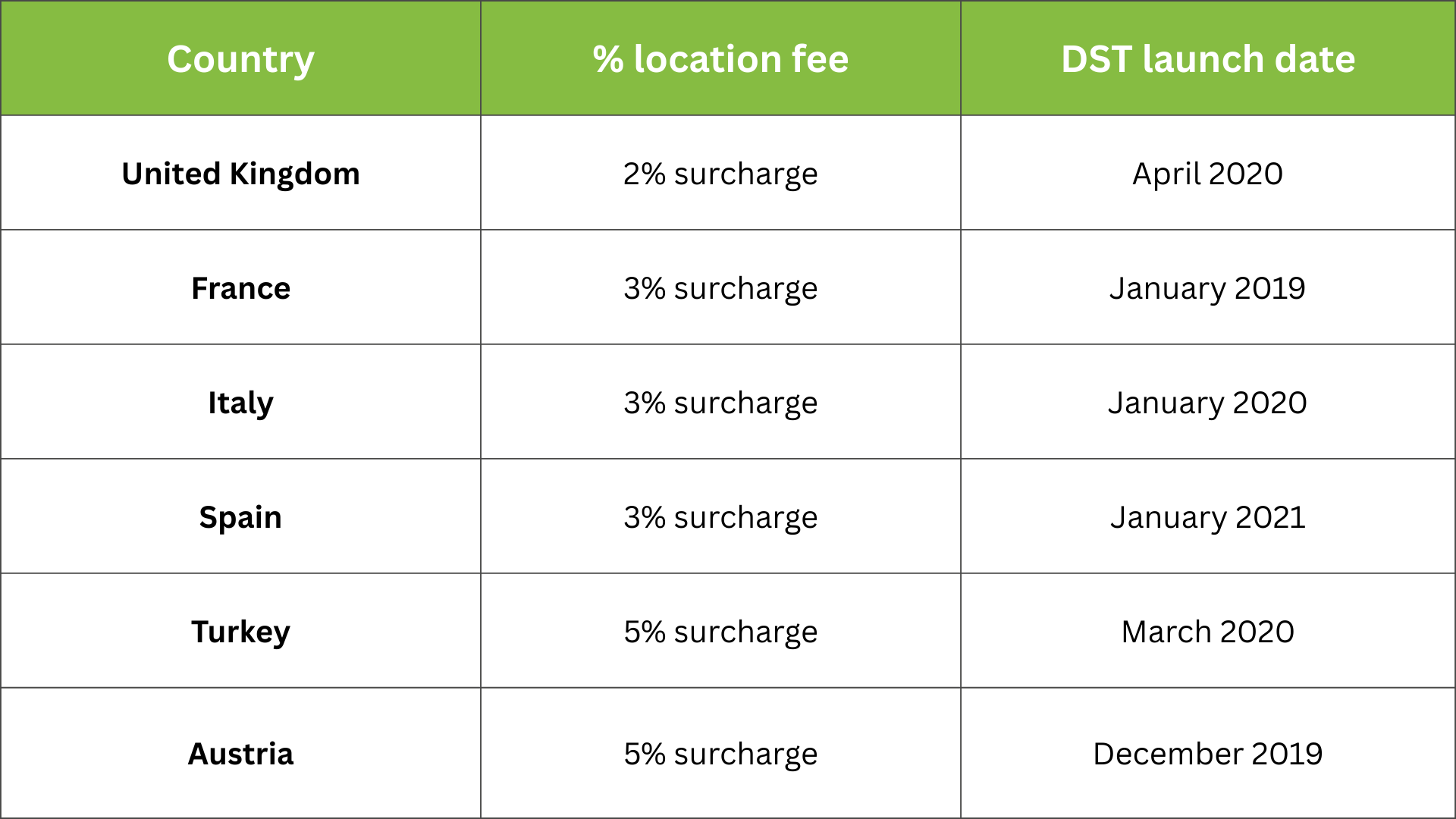
Meta has indicated that these jurisdictions and rates may change over time as the global regulatory landscape evolves. This doesn’t necessarily mean costs will rise. Turkey’s DST rate, for instance, is set to come down to 2.5% in early 2027.
Additionally, the above fees currently reflect the DST rate enforced by each country, but this may not always be the case.
Why don’t location fees always match the DST of a jurisdiction?
You might notice that while Meta’s fees currently mirror the headline DST rates (the official tax percentage set by the government), Google’s rates often vary. For example, Italy’s headline DST is 3%, yet Google only charges a 2.5% "Regulatory Operating Cost."
There are three main reasons why these rates might diverge:
- Regulatory operating costs vs tax fees: Google often brands these as "Regulatory Operating Costs" (ROC) rather than a direct DST fee. This allows them to set a fee that covers the cost of doing business in a country, rather than a 1:1 reimbursement of the tax. “Location costs” is Meta’s version.
- Different taxable bases: Governments calculate DST on a platform’s total revenue from digital services within their borders. The platform’s ad service might therefore only account for a fraction of the total fee, meaning they can charge advertisers slightly less than a country’s DST rate.
- Strategic absorption: In some competitive markets, a platform might choose to absorb a fraction of the tax to remain slightly more attractive to advertisers than their competitors. Conversely, in countries with high administrative complexity (like Turkey), Google actually charges 7%, which is higher than Meta's 5% fee. See all of Google’s latest location fees.
It’s helpful not to think of location fees as a fixed government tax like VAT. Ultimately, these are platform-set surcharges. While they are influenced by national taxes, they are commercial decisions made by Meta or Google.
As such, it’s best to check your monthly statements to stay on top of location charges - rather than relying on government tax news. Fluctuating platform surcharges can be confusing, but TDMP can manage these costs for you, ensuring your budget is strategically allocated to deliver maximum ROI regardless of fee changes. See our paid media services.
Which Meta advertising products are affected by location fees?
Facebook and Instagram
All ads across Facebook and Instagram will be subject to location fees, regardless of format. Whether you’re running an image, video, collection, carousel, or any other ad type on Facebook or Instagram, it will incur a charge upon delivery.
Meta’s location fees also apply to:
- WhatsApp click-to-message campaigns
- WhatsApp marketing messages that are invoiced together with ads
The charges will not apply to any other WhatsApp paid marketing, i.e. paid messaging beyond ad-linked campaigns.
How will location fees affect your billing for Meta ads?
It is important to understand that Meta will not deduct location fees from your set campaign budget. Instead, they are added as a separate line item after your ads have been delivered.
The maths: If you spend £100 delivering ads to an audience in the UK (2% fee):
- Ad delivery: £100
- Location fee: £2
- Total charge: £102 (plus any applicable VAT calculated on the total)
The fees will be itemised on your bill based on the charging location, e.g. ‘United Kingdom Digital Service’ - and will appear in two places:
- The ‘Billing and Payments’ section of Meta Business Suite
- Your monthly statements
How will location fees apply to multinational Meta ad campaigns?
Location fees are always tied to the country in which your ads are served, even for single campaigns targeting multiple different jurisdictions.
For example, a campaign split across the UK, France, and Austria will be subject to UK rates for impressions in the UK, French rates for impressions in France, and Austrian rates for impressions in Austria.
An easy way to forecast costs for complex, multi-country campaigns is to calculate a blended rate. This allows you to find a single percentage surcharge to apply to your total budget, rather than calculating each country individually.
To find your blended rate:
- Identify the percentage of delivery (share of spend) for each country.
- Multiply that share by the country’s specific fee rate.
- Add those totals together to get your final surcharge percentage.
Here’s an example:
- Your ad spend is £200,000
- 60% targets UK audiences, 30% targets French audiences, and 10% targets Austrian audiences
- Location fee formula - (0.60 x 2%) + (0.30 x 3%) + (0.10 x 5%) = 2.6%
- 2.6% of 200,000 = 5,200
- Your total location fees for all activity will be £5,200
- Your total spend will be £205,200 (+VAT)
Meta location fees: things to note moving forward
- Budgeting: Because these fees are added on top of your spend, you need to account for an extra 2%–5% in your total marketing budget if you are targeting these regions.
- Targeting accuracy: As with Google Ads, if your targeting settings are too broad, you may inadvertently serve impressions in a high-fee jurisdiction. Review your location targeting to ensure you aren't paying surcharges for regions that aren't core to your business goals.
Why is Meta choosing now to stop absorbing DST costs?
Meta hasn’t fully explained the reasoning for suddenly passing on location fees to its advertisers, but we can speculate based on the broader industry and Meta’s recent and planned activity.
One potential reason is simply that it’s now the industry norm for platforms to pass on these fees. Google, Amazon, and Apple have all taken this route, so most advertisers will likely be more understanding and accepting.
See our initial coverage of Google’s 2020 surcharge implementation.
It could also have something to do with funding the company's massive planned investments in AI infrastructure.
Concerned about your paid media ROI?
If you have concerns about your paid media ROI as we approach the July 2026 rollout of Meta’s location fees, we can help.
TDMP is an award-winning paid media agency with a proven track record of delivering exceptional results in the face of ad platform policy and broader regulatory complications.
Contact us today if you need help auditing your Meta ad accounts or adjusting your strategy to account for these new costs.