
With some Google Ads deadlines looming, March is shaping up to be crucial for advertisers. Plus, a new “Ask Maps” feature (essentially AI Mode within Google Maps) is shaking up local search.
We cover these updates and more in our latest search industry roundup.
Updates are colour coded by importance:
🔴 Major developments likely to impact strategy
🟡 Worth watching or understanding
🟢 Informative - but lower impact for most
SEO
🔴 Google launches “Ask Maps” for Google Maps
Google has launched “Ask Maps”, a new Google Maps feature powered by Gemini that helps users research local businesses, plan trips, and get personalised recommendations.
The feature is rolling out in the US and India on mobile (Android and iOS), with desktop support coming soon. Ads are not currently included, though this may change in the future.
For local businesses and marketers…
“Ask Maps” creates a new way for potential customers to discover and interact with your business through AI-driven queries.
It's a step away from traditional keyword-based local search to intent-based discovery. For example, instead of typing 'coffee shops near me', they may search 'where can I work for a few hours with reliable Wi-Fi and low noise'.
Before Ask Maps is rolled out in the UK, it's worth tightening up some signals that Google's AI can latch onto when responding to queries:
- Make sure you're using descriptive business attributes on your GBP - Attributes like “good for groups”, “pet‑friendly”, “wheelchair accessible”, or “LGBTQ+ friendly” help AI match your business to nuanced queries.
- Maintain entity clarity - Ensure the information on your website, social profiles, and GBP is consistent. Google’s AI may cross-references these sources to verify your business’s identity. If your reviews mention a "famous Sunday Roast" but your website menu doesn't list it, the AI may lack the "confidence" to recommend you for related queries.
- Improve visual content - Photos can influence how AI describes ambience, products, and facilities. Add high‑quality images and monitor user‑generated ones.
- Encourage detailed reviews - Google’s AI will likely use reviews as a primary data source for matching businesses to conversational queries. When customers naturally mention specific attributes (like ‘spacious outdoor seating’ or ‘fast EV charging’), it gives Google stronger signals about what you’re known for. You shouldn’t tell customers what to write, but you can focus on delivering and showcasing those strengths in your operations, website, photos, and GBP attributes - so that, if people choose to leave a review, those details tend to show up organically.
🟡 Google claims JavaScript doesn’t block content
Google has removed a “Design for accessibility” section from its JavaScript SEO documentation, stating the guidance was outdated and no longer useful.
The removed content previously encouraged testing sites without JavaScript to identify content that might be inaccessible to users or search engines. Google now emphasises that its systems have been rendering JavaScript for years, and that loading content via JavaScript does not inherently make it harder for Google Search to access or understand pages.
For SEOs and website owners…
Take Google's word with a pinch of salt here. While Google maintains that JavaScript is no longer a barrier to crawling, its own performance guidance (particularly its help docs for developers) and tooling still highlight risks around overuse, rendering delays, and script errors, meaning careful implementation is important.
Additionally, Google claiming JavaScript rendering isn’t a problem for them doesn’t mean it isn't a problem for other search engines or tools. It’s still worth validating how your content is rendered (e.g. via server-side rendering, dynamic rendering, or testing rendered HTML output), especially for critical pages.
In short, don’t take Google’s new stance to mean JavaScript is never an issue. Stick to technical SEO fundamentals to protect visibility. Contact TDMP today to request a free technical SEO audit.
🟡 AI Overviews becoming more common - and less reliant on top-ranking websites
New research from BrightEdge shows that AI Overviews are continuing to expand across sectors, now triggering for nearly half of tracked queries.
AIO growth has been especially strong in:
- Education
- B2B technology
- Restaurants
- Healthcare
- Insurance
- Entertainment
- Travel
- eCommerce
- Finance
The research also highlighted that AI Overviews now often cite websites that do not rank on Google’s first page. Historically, AIO primarily pulled from top-ranking organic pages.
For marketers and content creators…
This doesn’t mean organic performance is irrelevant. Roughly 50% of queries still return a traditional SERP.
However, when AI Overviews are served, content quality, clarity, and authority matter more than sheer ranking. Even lower-ranked or less prominent pages can be selected as sources if they provide clear, concise answers to the search query of AIO’s sub-queries.
🟡 Gemini and Google Search may never fully merge
In a recent interview, Liz Reid, Google’s Head of Search, mentioned that she’s not sure that Google will ever fully merge Gemini with Google Search, despite both being powered by similar underlying models.
Instead, the two are evolving as complementary but distinct experiences, with Gemini focused more on productivity and content creation, and Search on discovering information and connecting users with the web.
For marketers and SEOs…
This could be a sign that we’re reaching a more stable period in search, where there isn’t a huge disruptor on the immediate horizon. For now, the standard is a multi-surface ecosystem where users move between tools depending on intent.
Traditional search visibility (rankings, indexing, SERP features) is still crucially important and will remain so. However, separate consideration for AI-driven environments can be helpful.
🟡 OpenAI’s GPT-5.3 Instant shows fewer website links by design
OpenAI has introduced GPT-5.3 Instant, highlighting improvements in answer quality, context, and conversational flow. However, this model will rely less on presenting long lists of links and instead synthesise information into more complete, direct answers.
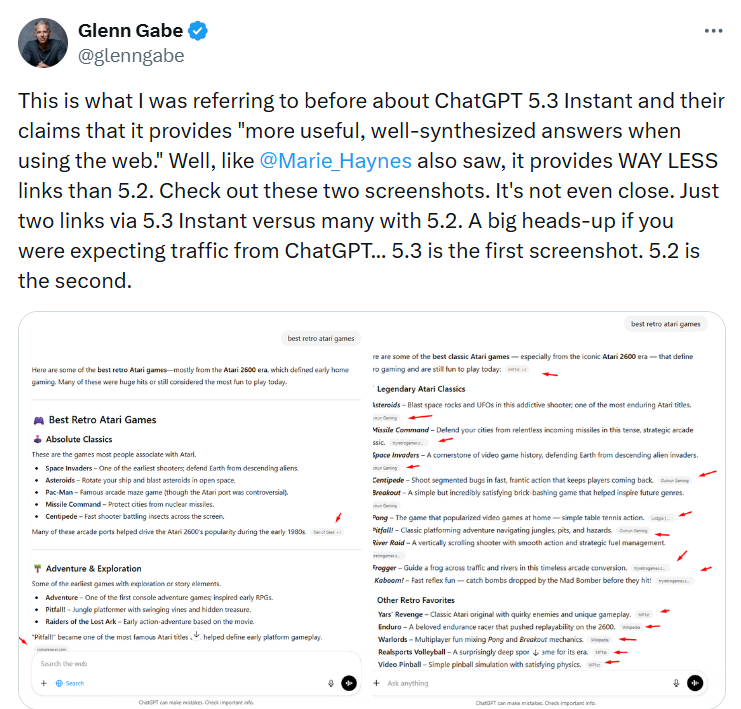
Source: X
OpenAI says the model is now less likely to “overindex” on web results, instead blending real-time information with its own reasoning to produce more useful responses upfront.
For marketers…
This pushes search behaviour further away from clicks and toward answers. If ChatGPT is surfacing fewer links and more complete responses, the opportunity to win traffic shrinks.
As OpenAI says, Instant is ‘ChatGPT’s most-used model’, so it’s a shame it’s here that they’ve decided to cut down on source links. But you can still be chosen and cited if your content is clear, authoritative, and easily extractable by AI systems.
🟢 Google answers FAQs about their web crawling in new help doc
Google has published a new help document, Things to know about Google’s web crawling, aimed at clarifying how its crawling systems work.
The guide outlines nine key points, including what crawling is, the existence of multiple crawlers with different roles, and the fact that crawling is ongoing to keep search results fresh.
There has been a lot of negative discussion around crawling as of late, (particularly around the frequency of AI crawls), so perhaps this is Google’s way of bringing tensions down and reminding that crawling is an essential part of search.
If you have any questions about Google’s web crawling, this is a helpful resource.
Paid Media
🔴 Google Ads wants confirmation whether campaigns contain EU political content - imminent deadline
Google is sending notices to advertisers asking them to confirm whether their campaigns include European Union political content, as part of new EU transparency requirements. The declaration must be completed by 31 March 2026 at either campaign or account level.
This requirement applies globally (including to UK advertisers) because campaigns using broad or multi‑country targeting (such as YouTube, Display, or Performance Max) can reach EU users.
For advertisers…
If you miss the deadline, you could face campaign disruption, ranging from ads being limited or paused, to potential account-level restrictions if Google can’t verify whether your ads fall under EU political classifications.
Even if you’re confident your campaigns aren’t political, it’s still important to actively confirm that status. For in-house teams managing multiple accounts or campaigns, this is a quick but critical audit task.
🔴 Google rolling out AI voice models for silent PMax video ads - by default
Google is rolling out AI‑generated voiceovers for Performance Max video ads. The feature automatically adds a synthetic voice layer to silent video assets by pulling from your existing headlines and descriptions, then generating a new video variant with the voiceover applied.
Ads that already include voice will not be altered. Advertisers can opt out of this enhancement until 20 March 2026. After that, any campaign with Video Enhancements enabled may serve voice‑enhanced versions by default.
Google will store both the original silent video and the new voice‑enhanced version, choosing which to serve based on predicted performance.
For advertisers…
While the feature could result in higher engagement with minimal effort, several potential issues merit attention:
- Brand identity risks – AI-generated voices are uniform and generic. The tonal qualities, cadence, and emotional expression of the voice may not align with your brand’s identity. For premium or carefully branded campaigns, this could dilute differentiation and affect how audiences perceive your messaging.
- Creative execution concerns – Headlines and descriptions written for display or static ads may not translate naturally when spoken aloud. AI pacing, emphasis, and inflection could make the message feel awkward or misaligned with intended voice and tone.
- Compliance and regulatory risks – For regulated industries (finance, healthcare, legal, insurance), mandatory disclosures or required phrasing could be misrepresented in AI-generated voiceovers. The system may reorder text or omit critical disclaimers, creating compliance exposure even if the original text assets are compliant.
- Default opt-out framing – Like previous Performance Max automation features, this rollout is opt-out rather than opt-in. Advertisers must proactively decide whether to disable it before March 20, 2026, to avoid unwanted deployment of AI-generated audio on their campaigns.
🟡 Study shows benefits and limitations of AI Max in Google Ads
New research from Smarter Ecommerce analysed 250+ Search campaigns using AI Max, revealing some interesting patterns:
- Only 22% of campaigns achieved target ROAS. 42% were above target, while 35% were below target
- Medium conversion value increased by 13%, while CPC increased by 16%
It also supported the idea we covered in an earlier roundup that AI Max broadens exact match and phrase match keywords rather than building from broad match.
For advertisers…
The first thing to note is that the study focused on e-commerce campaigns, so the results may not mirror AI Max performance for other business/campaign types. But, broadly speaking, there are some interesting points to highlight.
The data shows that performance with AI Max varies widely. Some campaigns greatly exceed ROAS targets, while others underperform, highlighting that success depends heavily on account structure, keyword coverage, and campaign setup.
AI Max should therefore be treated as a strategic expansion tool, not the foundation of your campaigns. Instead of relying on it from the start, hoping you’ll be one of the lucky ones that lands above target, start with a well-structured, high-quality Search campaign, then layer AI Max selectively to capture incremental conversions. Monitor performance closely and adjust as needed to ensure it contributes positively to your goals.
If you’re unsure how (or if) AI Max should factor into your paid media activity, we can help you design, test, and optimise campaigns to make the most of this tool while protecting efficiency. Request a free PPC audit.
🟢 Survey suggests PPC is becoming more difficult
The latest State of PPC report from PPCSurvey provides a comprehensive look at the current state of pay-per-click advertising, drawing on responses from over 1,000 practitioners across agencies and in-house teams.
Among the findings, just 16% of respondents felt PPC is easier today than two years ago, while a majority (53%) said it’s harder. Automation, AI/LLMs, and improved targeting were cited as reasons some find it easier, but most marketers pointed to less transparency from ad platforms, reduced accuracy, increased competition, and decreased control as the drivers of growing difficulty.
For marketers and advertisers…
PPC is evolving rapidly, and managing campaigns effectively is becoming more complex. While automation and AI can help, strategic human oversight, expert optimisation, and careful interpretation of platform data are essential to drive results.
This is why blindly following AI-generated ad platform recommendations doesn’t lead to the best outcomes. With the right partner, however, PPC can be a highly effective revenue generator while also helping you achieve strategic marketing goals.
If navigating platform changes and rising competition feels overwhelming, let’s talk. TDMP is an award-winning PPC agency with a proven track record of delivering exceptional results, even in highly regulated markets.
Stay current with TDMP
Digital marketing is moving fast, and staying on top of updates, AI features, and search trends is key to maintaining a competitive edge. If you want expert guidance on optimising your organic and paid digital impact, contact TDMP today.
Explore our previous 2026 roundups: