

November delivered some big shifts across search, from CTR declines and evolving AI search behaviour to a major Cloudflare outage and early mention of ads coming to ChatGPT.
Below, we’ve rounded up the updates that matter most for website owners, advertisers and marketers so you can stay ahead and get the most out of digital.
Updates are colour coded by importance:
🔴 Major developments likely to impact strategy
🟡 Worth watching or understanding
🟢 Informative - but lower impact for most
Google Search
🔴 CTR still in decline on Google’s SERPs - but not just because of AI Overviews
Seer interaction has updated an earlier report on declining click-through rates with new data. The initial report aimed to track the impact of AI Overviews on CTR from Google’s search results, but the new data reveals it’s not just AIO to blame.
Unsurprisingly, click-through rates are lowest when there’s an AIO present, showing a 65% YoY decline, but there’s also a 46% drop in clicks to organic listings when there is no AIO hogging the top spot on the SERP.
Part of the problem is that even when Google does not serve an AIO, there are often still plenty of rich results that aim to satisfy user requests directly on the SERP. Another factor is that some are going straight to search alternatives like ChatGPT, avoiding Google altogether.
For marketers…
The decline in clicks is least pronounced when an AI Overview is present with your content cited, so building a presence in these generated summaries is key for the time being.
Contact TDMP today for AI-aware SEO support aimed at increasing both your organic rank and your presence in AI Overviews.
Simple, higher funnel queries are seeing the biggest drops, so consider aiming for lower funnel and conversational queries that address more specific subtopics.
🔴 Google states that incentivised reviews must be labelled
Towards the end of November, Google began sending an email to merchants and advertisers stating that any reviews “boosted by incentives (gift cards, rewards points, discounts)” need to be labelled as such.
The goal is to provide full transparency to people reading your reviews when deciding whether to use your services or buy your products.
This marks the beginning of Google’s pledge to the UK Competition and Markets Authority (CMA) to make significant changes to processes in order to weed out fake reviews or those with undisclosed incentives.
For marketers…
All businesses with incentivised online reviews must use the [incentivized_review] attribute to clearly disclose the role of incentives in the review process. These reviews will still be surfaced by Google, but they will be tagged as incentivised. (Note: This tagging primarily applies to third-party merchant and product reviews. Incentivised reviews are strictly prohibited on your main Google Business Profile/Maps listing.)
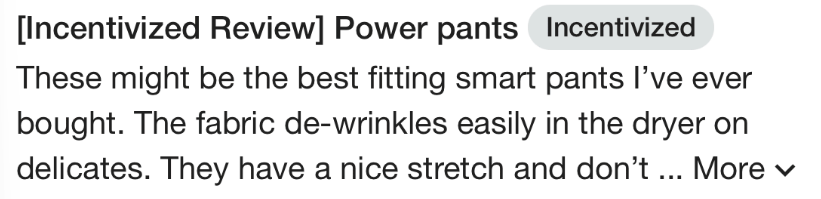
Source: Search Engine Roundtable
Part of Google’s commitment to the CMA is establishing a pathway for consumers to report reviews with undisclosed incentives, as well as building algorithmic detection into their evaluation processes.
Businesses found to be publishing incentivised reviews without the new attribute will likely face manual actions and account closures. But these new rules and the penalties for flouting them don’t start and end with Google.
The CMA can issue penalties for businesses publishing any fake or non-labelled incentivised reviews anywhere online, and the fines can be extensive!
🔴 Google AI Mode gets 3 new agentic capabilities in the US
Google' s AI Mode can now book event tickets, beauty appointments, and wellness appointments on a user’s behalf. While this is only live for US users opted into Search Labs, it’s a taste of what’s to come in the UK at a later date.
For marketers…
Agentic AI is going to advance rapidly, and adoption rates will pick up as the service improves. Typically, the user does have to confirm the recommended booking, but they’re not weighing up the options or taking actions on websites.
This means optimising webpages and content for AI actionability will become just as important as optimising for AI discoverability.
Some tips at this early stage include:
- Provide machine-readable structure
- Make the page’s intent obvious
- Prioritise clarity over stylistic flourish
- Offer clean, direct action paths
- Expose APIs or clear instructions for actions
- Keep information up-to-date and consistent
- Include edge-case and boundary details - i.e. Shipping cutoffs, refund rules, compatibility notes, etc.
🟡 Cloudflare outage blocks access to several sites
Cloudflare, the web tech company responsible for the security of roughly 20% of the internet, started showing a 5XX error when users attempted to visit certain sites on its network.
The issue was widespread, impacting all manner of websites, including major operations such as OpenAI, X, and Spotify, as well as several SME sites.
Cloudflare was quick to acknowledge and seek a resolution for the error, solving the problem over roughly 24 hours.
For website owners…
Unfortunately, there’s no getting away from the fact that potential customers may have been turned around at the door during this outage, but the good news is that there shouldn’t be any major SEO or PPC implications.
5XX errors typically slow down Google’s crawlers, but as long as the issue is resolved swiftly (which it was), there aren’t usually any visibility or performance losses. If you did notice a slight dip in performance on your analytics tools, you should by now have seen a recovery.
If previous performance hasn’t yet been recovered, there may be an underlying issue. Contact TDMP today for a free SEO or PPC audit.
Google SEO
🟡 Google Business Profiles get native scheduling and multisite publishing
You can now schedule posts on your Google Business Profile rather than posting immediately or scheduling via third-party tools.
You can also post one update across multiple business profiles, while, before, you’d have to post on each profile individually. For example, if you had 10 locations (e.g., a chain of coffee shops), you had to copy-paste the same update 10 times. Now it’s one and done.
For businesses…
With the busy Christmas period upon us, these new features are landing just in time. Use them to get ahead of hectic schedules and make sure your brand’s messaging is visible during the time of year most people are actively searching.
🟡 Position 1 of branded searches are losing clicks
Position 1 of Google’s organic listings is losing clicks in branded searches, suggests AWR’s Q3 2025 CTR report. So where are people going instead of the top spot? Well, anywhere between positions 2 and 6, according to the data.
Position 1 lost 1.52% CTR while positions 2 through 6 gained 8.71% collectively.
The underlying reason is that people want immediacy, even outside of AI search. They don’t want to navigate to a homepage and pinball down eventually to the right location; they want to go directly to the page they need on your site.
Another potential factor is that some people are purposefully scrolling beyond SERP features crowding the top levels of the results before considering options.
For site owners and marketers…
Ultimately, your goal should be to own those top 6 positions for branded searches so those wandering clicks stay within your ecosystem. You may be thinking that this is easier said than done, but remember, the focus is securing visibility for searches that contain your brand name specifically, so you hold the ultimate home-field advantage.
You aren't competing for high-difficulty generic keywords; you are simply positioning the assets you already control (social profiles, support pages, and About sections, etc.) to be the obvious choice for Google to display.
Something else you can do to help users get where they need to be quicker is to optimise for sitelinks on Google’s SERPs. For the uninitiated, sitelinks are a rich feature. These are individual links to different key areas of your website, placed beneath your main blue link listing.
There’s no way to force Google to serve sitelinks with your listing, and certain contributing factors are beyond influence, but you can guide the algorithm by mirroring the user journey you want to create. If your navigation menu and internal hierarchy clearly prioritise pages like 'Login,' 'Pricing,' or 'Support,' Google is far more likely to pick those up as helpful shortcuts.
🟡 Llms.txt has no clear impact on how AI uses your content
A new analysis of over 300 thousand domains has introduced more evidence that the llms.txt file is currently ineffective.
As discussed in our guide, Robots/txt, AI crawlers, and what (if anything) you should be doing about it, llms.txt is a new directive introduced to give you more control over how AI can use your content - or if it can access it at all.
It’s very new and unenforced, meaning compliance from AI providers is entirely voluntary.
Findings reveal that implementing llms.txt had almost no impact on how AI accesses and uses content. The only shift observed was that an AI’s outputs tended to be slightly more accurate when llms.txt files were removed.
For site owners…
As we concluded in our guide, there’s no need to implement llms.txt at the moment. Even when using it to try and give AI crawlers clarity and increase citations, the only measurable impact is that outputs are less accurate.
It could be something to consider in the future, but for now, most are better off taking proactive measures to boost visibility in AI results - contact TDMP today to start building visibility in AI search.
Microsoft Copilot
🟡 Copilot gets live search functionality - with publisher-kind citations
On November 10th, Microsoft launched Copilot’s dedicated search experience. Unlike Google’s AI Overviews, AI Mode, and Gemini, it appears to allocate some major UI real estate to key sources, making it easier for users to click through to websites.
Primary sources that best meet user search intent can appear prominently above the generated output, with the response itself explaining the value of the source before offering more detailed guidance.
Small citations buttons are given within the output next to the relevant information, and finally an option to see all references opens a user-friendly side menu for easy navigation to source websites.
For publishers…
This is the kind of approach we’d like to see not just Google taking but all AI search providers. We’ll have to wait and see what data surfaces on CTR from Copilot, but Microsoft's citation approach does appear to be making it easier for users to click out of the response.
Paid Media
🔴 Ads will be coming to ChatGPT
In a recent interview, Sam Altman, CEO of OpenAI, stated that ads will be coming to ChatGPT at some point - all while taking the opportunity to drag Google’s paid media model.
Altman’s argument is that Google’s paid model inherently harms the user experience and therefore the trust between user and platform by placing potentially lower quality paid-for listings above the best (organic) options.
While providing no details about what ads will look like in ChatGPT, he assured that he had something in mind that might work.
For advertisers…
Google still holds the lion’s share of the search market, but with ChatGPT approaching mass adoption, by the time OpenAI rolls out ads on the platform, it may be a fantastic way to generate high quality leads.
The conversation history in AI chat helps guide users through the decision-making process, and it also provides the AI with rich context to serve an ad that is precisely matched to the user's intent.
Additionally, one of Altman’s refrains in the interview was that people are trusting ChatGPT more and more, and this could also form a major aspect of paid clicks through the platform. If people trust ChatGPT to suggest only the very best services or products for their needs, they’re more likely to run with the recommendation.
Think of it as the difference between your good friend giving you a recommendation vs a stranger on the street.
🟡 New bidding type in Google Ads - coming in 2026
Google Ads is reportedly preparing to launch a new bidding type called Journey Aware bidding in 2026, starting with Search campaigns using Target CPA.
The feature is designed to account for complex, multistep purchase journeys by letting advertisers signal additional steps in the funnel without turning them into counted conversions. In short, it gives Smart Bidding more context across the lead-to-sale journey, helping it make more informed bidding decisions.
For advertisers…
If you manage multistep lead generation or long sales cycles, Journey Aware bidding could become a cleaner, more elegant alternative to workarounds like micro-conversions, manual lead scoring, or homemade value-based bidding setups.
That said, it will require accurate conversion mapping and categorisation to work well. Expect some early-stage quirks as the feature rolls out, but this is likely a meaningful upgrade for advertisers who struggle with gaps between early-stage engagement and true revenue-driving outcomes.
Data & privacy
🟡 The EU may ease cookie consent rules momentarily
The EU is proposing something called the Digital Omnibus, which would momentarily simplify parts of the GDPR to make compliance more manageable. It covers a broad spectrum of areas, but for the purposes of general marketing, it’s the changes to cookie consent rules that you should follow.
In short, the EU Commission wants to address “banner fatigue” by transitioning more control into browser-level settings and removing some non-risk cookies from the scope of consent pop-ups.
For marketers…
To be clear, no laws have been amended by the Digital Omnibus yet, but if you receive traffic from Europe, it may have an impact on your data gathering and usage, so it’s important to monitor progress.
As for whether the changes will be beneficial… It's a mixed bag.
Fewer consent banners improves the user experience, and you’ll get some low-risk cookies to work with regardless of consent. Compliance should indeed be easier on the whole as well.
But aspects like browser-level privacy settings may remove lots of user data currently up for grabs, and a more explicit single-click reject option is expected to reduce the total numbers of users who consent to tracking.
Stay current with TDMP
That’s it for this month’s key developments. With ads in ChatGPT on the horizon and clicks in constant flux, there’s a lot to contend with and prepare for to optimise digital strategies and get the most out of marketing budgets. If you want help turning these shifts into growth, get in touch with TDMP today.