

SparkToro, in collaboration with Similarweb, has released the latest findings of its ongoing zero-click study, revealing that not only is the zero-click trend still present in the US, but that it’s actually accelerating over time.
Following the US data, an expanded report was published, documenting the current state of zero-click searches in various other nations. And of the analysed nations, zero click searches were found to be most prevalent in the UK.
Here, we provide an overview of the findings and attempt to identify some potential factors contributing to the UK’s leading position in the rising zero-click phenomenon.
The state of zero-clicks in 2026 - What did the report reveal
SparkToro and Similarweb’s report tracked zero-click behaviour across the following nations:
- UK
- France
- Germany
- Italy
- USA
- Canada
The US data
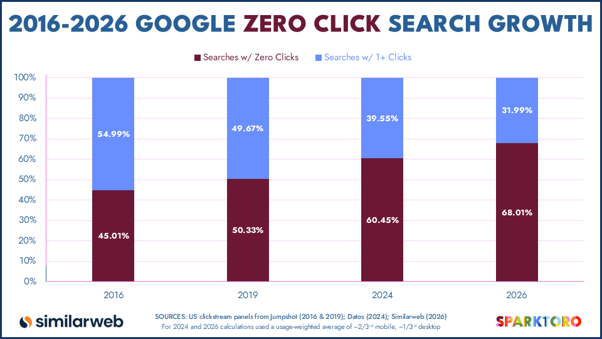
The US pillar of the SparkToro study is the most robust, offering a detailed 2016-2026 zero-click comparison:
Source: SparkToro
For the first four months of 2026, over 68% of US Google searches ended without a single click. This means the acceleration of zero-clicks between 2024 and 2026 was almost on par with that of the five-year window between 2019 and 2024.
The UK, Europe & Canada data
The UK, European, and Canadian data is a fresh addition to the study, so there was no historical data to compare the findings against, but it was revealing nonetheless.
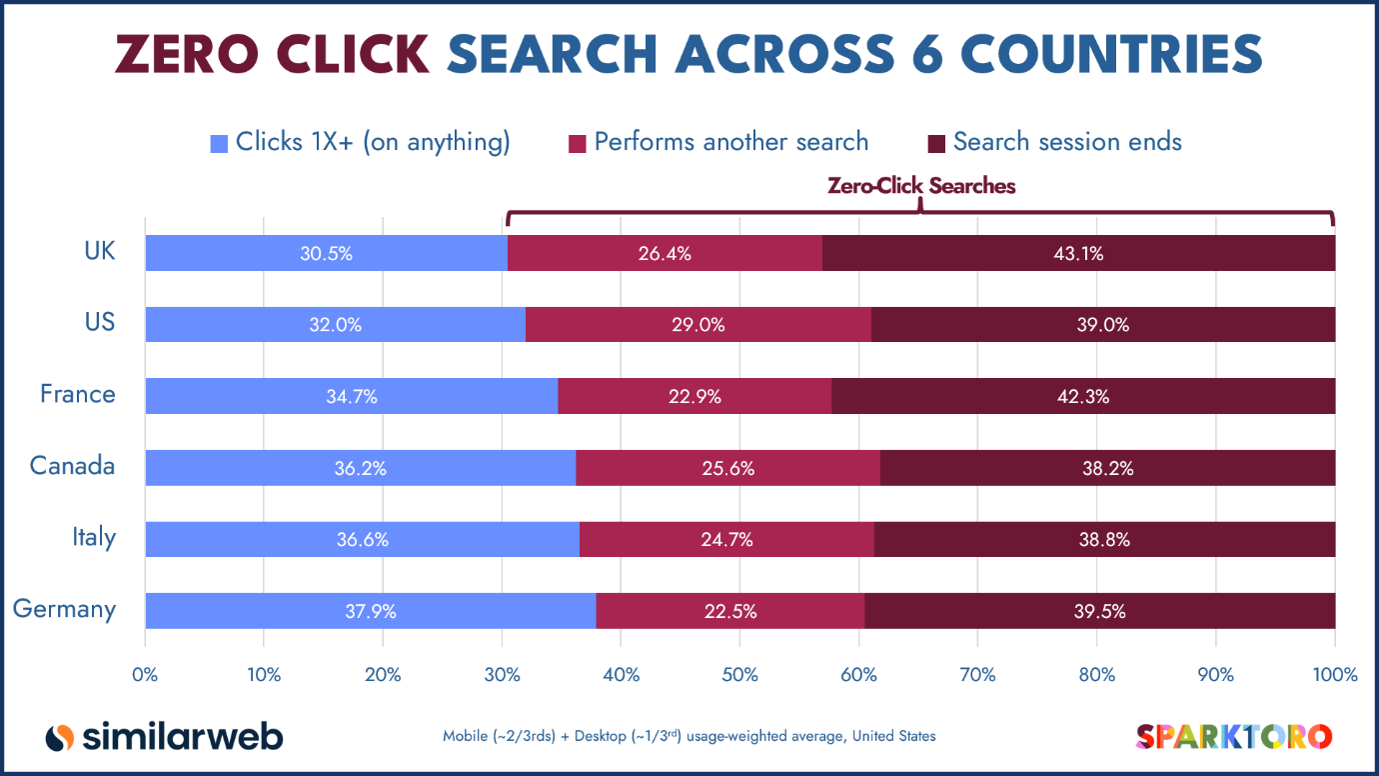
As of the end of the observation period, the UK had the highest rate of zero-click searches of all countries analysed - including the USA:
- UK - 69.5%
- US - 68%
- France - 65.3%
- Canada - 63.8%
- Italy - 63.4%
- Germany - 62.1%
Source: SparkToro
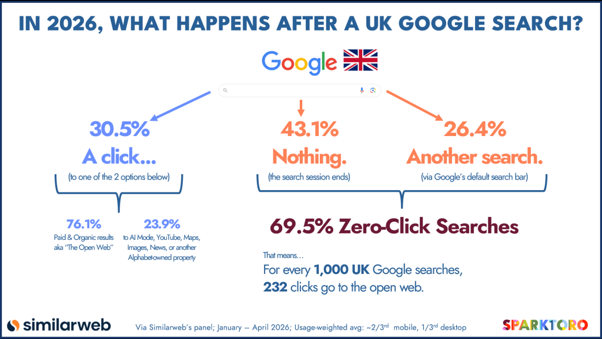
The report also included the following “map” explaining in detail what happens following a Google search in the UK when the user clicks vs when they don’t:
Source: SparkToro
Let’s unpack the data points:
- The percentage of clicks staying within the Google ecosystem – Of the 30.5% of searches that result in a click, 23.9% lead to another Google/Alphabet property. Most of the time, these can effectively be thought of as zero-clicks searches.
- The search-to-click ratio - Subtracting those clicks to Google-owned properties, there are 2.32 clicks for every 10 searches. Another way of putting that: only 23.2% of total searches lead to the open web, meaning digital is more competitive than ever.
- 26.4% of zero-click searches lead to another search - This suggests 1 of the following scenarios:
- Information found on the SERP was helpful but only part of a larger research task
- Google’s results were unsuccessful in meeting the search intent
- Google’s results were appropriate, but the search query was suboptimal
- The initial search was successful (not a failure by Google or a bad query by the user), but the SERP's design inherently prompted a brand-new search.
- 43.1% of searches stop dead without a click - These are the searchers finding exactly what they need, in full, directly on Google’s SERP. It seems troubling, but when you consider that around 52% of Google searches are informational(1), often easily handled by AI Overviews, it could be worse.
If you're concerned about these figures, we can help. TDMP has a proven track record of helping businesses buck downward search trends and thrive online. Contact the team today to get started.
Why are zero-click searches so prevalent in the UK? - Potential factors explored
There’s no easy answer to why the UK scores so high for zero-click searches. It’s likely a complex mixture of cultural, linguistic and practical causes, but we wanted to explore some tangible factors that could feasibly be contributing to the issue.
1. Lack of EU regulation
The SparkToro report itself speculates that the EU’s strict laws restricting Google’s self-preferential tactics could be a reason European nations are more likely to click.
Following Brexit, the UK is no longer bound by the EU’s Digital Markets Act (DMA), designed to prevent tech leaders from favouring their own services over independent competitors.
EU countries like Germany and France benefit from forced design guardrails that may encourage outward clicks, but Google has much more freedom in the UK market to experiment with changes with click-reducing potential.
It’s certainly plausible, but we’d like to see a pre- and post-Brexit zero-click data comparison to see just how much weight this theory carries.
In positive news for UK website owners, the Competition and Markets Authority (CMA) is pushing Google to offer more transparency and control regarding their AI search features, like AI Overviews.
This pressure has already resulted in AI performance reports in Search Console, and future legislation may even help to slow zero-clicks down.
2. Frequency of AI Overviews
AI Overviews are known to reduce CTR by around 58%(2), so the nations that see the most AI Overviews should, in theory, be more likely to have higher rates of zero-click searches. We looked into it, and, with the exception of the USA, AI Overviews are indeed served in the UK more than in all the other analysed nations.
Related - Evolution of AI Overviews - a stage-by-stage breakdown of real-world search impact (2023-2026)
An analysis of 108 million queries around the world revealed that the UK was served 4.387 million AI Overviews. Of the subject nations, Germany was the closest to the UK, with 3.918 million overviews served. The US led by a country mile with 28.761 million overviews.
This makes sense, as AI Overviews are statistically more likely to trigger for English-language queries(3). Google is also more likely to test algorithm adjustments with English-language queries before approving them for wider implementation, so the recent increase in AI Overviews being served for non-informational queries may be contributing to more AI Overviews in the UK as well.
It’s not conclusive data, and the order of the nations in terms of overview density doesn’t align with the zero-click pecking order, but this could be due to the influence of additional factors.
3. Heavily mobile-leaning search culture
Mobile has a 77% zero-click rate compared to desktop’s 56%(4). Therefore, in counties with search behaviours that skew heavily towards mobile, zero-click searches could be more prevalent.
But does the UK rely more on mobile search than the five other subject nations? Quite possibly. A 2021 Sistrix study updated in 2025 revealed that, of the nations in question, the UK was second only to Italy in terms of mobile search volume.
As of May 2026, 67.94% of UK web traffic comes from mobile(5), more than any other subject nation. For comparison, only 50.92% of web traffic starts on mobile in Italy in 2026(6).
It’s possible that, because zero‑click searches are more common on mobile, the UK’s higher share of mobile traffic has pushed its zero‑click rate up in proportion to its overall search volume. That said, this remains speculative.
Another possibility is that British and Italian mobile search behaviour simply differs. Italians may still be searching heavily on mobile, but, whether for cultural, UX, or other reasons, may be less inclined to click through.
4. AI adoption and trust of AI
Another factor that may help explain the UK’s unusually high zero‑click rate is its comparatively strong adoption of and growing comfort with AI‑powered tools.
In 2026, the UK ranks second among the nations analysed for AI adoption, behind only France(7). And that willingness to use AI appears to be accompanied by rising public trust levels.
In 2023, around 34% of the UK population said they were willing to trust AI, ahead of France (31%) and Canada (32%), but behind Germany (35%) and the US (40%)(8). Fast‑forward to 2026, and UK trust has climbed to 42%(9), edging slightly ahead of the USA’s 2025 trust rate of 41%(10).
France’s latest figures show 36% of the public expressing some level of trust, with 6% reporting strong confidence(11). Whether that should be interpreted as a combined 42% is debatable.
France is often characterised as one of Europe’s more sceptical nations when it comes to AI, but “scepticism” can refer to concerns about AI’s societal impact, which doesn’t necessarily map cleanly onto whether someone trusts AI in the moment of use.
Either way, the UK is right up there among the most trusting nations, and if UK users are more willing to accept AI‑generated answers at face value, that could naturally translate into higher zero‑click behaviour.
This doesn’t prove causation, but it does sketch a plausible behavioural backdrop.
What can UK sites do to combat zero-click searches?
Even in a zero‑click landscape, UK brands aren’t powerless. Google can surface summaries, AI Overviews and quick answers, but it can’t replicate what real businesses offer: products, services, and lived experience. The sites that win clicks are the ones that give searchers something AI simply can’t deliver, whether that’s depth, authority, originality, or a clear next step.
For UK organisations, the opportunity now is to double down on that differentiation. Strengthen the content only you can produce, make a big noise about what makes your business and your solutions special, and optimise for the journeys where users do still click.
Contact TDMP today to make sure that when someone needs more than a snippet, you’re the obvious destination - Let’s talk.
Citations
- New Research: We analyzed 332 million queries over 21 months to uncover never-before-published data on how people use Google – SparkToro
- Update: AI Overviews Reduce Clicks by 58% - Ahrefs
- AI Overviews (SGE) Statistics 2026 – Searchlab
- Zero-Click Searches Statistics 2026 – Searchlab
- United Kingdom Mobile vs Desktop vs Tablet Traffic Market Share – Similarweb
- Mobile Internet Usage by Country: Device Share Statistics for 2026 (June 2026 Update) – Technologytracker
- Mapped: AI Adoption by Country in 2026 – Visualcapitalist
- Trust in artificial intelligence: Country insights on shifting public perceptions of AI – KPMG
- UK attitudes to AI - KPMG
- Trust in AI in 2025 – KPMG
- How do the French relate to artificial intelligence? – Labo Société Numérique