

Mid-December brings another wave of meaningful changes across search, AI and paid media, including a new core algorithm update from Google, multiple new pathways to AI Mode, and shifting keyword controls in paid search.
Here’s what marketers, advertisers and website owners need to know and why.
Updates are colour coded by importance:
🔴 Major developments likely to impact strategy
🟡 Worth watching or understanding
🟢 Informative - but lower impact for most
Google Search
🔴 Google rolling out December 2025 core algorithm update
Google has announced the rollout of the December 2025 core algorithm update, which began on December 11th. Rank volatility started to increase on the 12th, dipped, then spiked on the 13th. The SERPs have since stabilised, but usually there is at least one more rough patch as the update approaches completion.
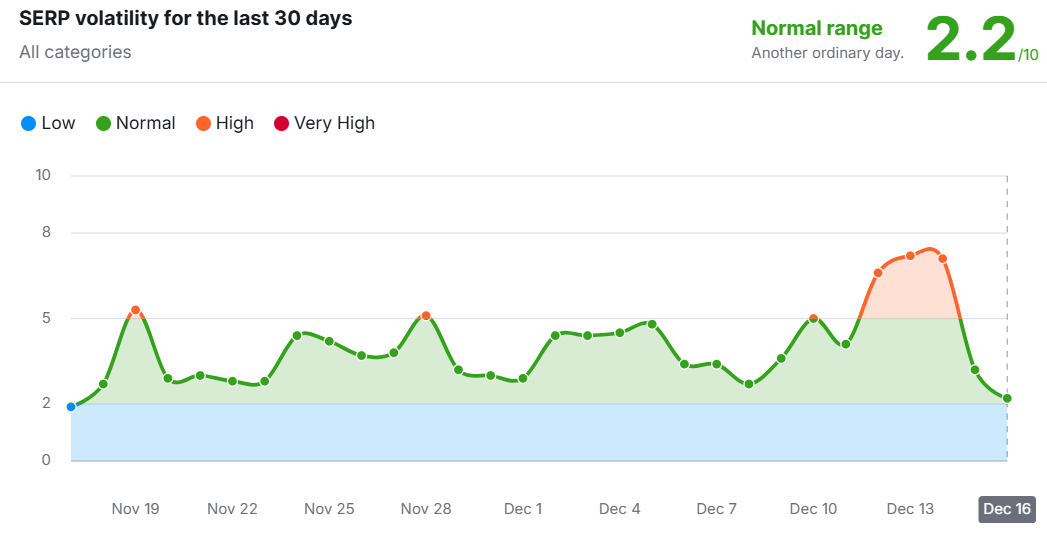
According to Google, this update may take up to three weeks to fully roll out. As with previous core updates, Google describes it as a regular update designed to better surface relevant, satisfying content for searchers across all types of sites.
At this early stage, there are no confirmed nuances regarding the scope of the update. However, initial industry chatter suggests that recently updated content may be seeing a modest boost, while some older content appears to be slipping slightly.
This is the third core update of 2025, following updates in March and June. Google typically rolls out around four core updates per year, so having only three so far is somewhat unusual — especially given that Googlers have previously indicated we should expect updates more frequently.
For website owners…
As with any Google update, it’s important to stay calm and avoid making reactive changes based on short-term ranking fluctuations. Wait until the rollout is fully complete before drawing conclusions. Once volatility subsides and the SERPs stabilise, you’ll be in a much better position to accurately assess the impact and plan your next steps strategically.
We’ll be posting an in-depth overview of the December 2020 core update to our live history of Google updates as soon as roll out is complete.
Here are some helpful things you can do in the meantime:
- Monitor rankings and traffic trends daily, but avoid knee-jerk changes
- Annotate the update start date in GA / GSC for clearer analysis later
- Watch key pages and query groups rather than individual keyword swings
- Compare performance of recently updated content vs. older pages
- Once finished, audit pages that saw the biggest gains or losses
If you’d like support not just surviving, but thriving in the face of Google updates, contact TDMP today.
🔴 Gemini can now output rich results for local queries
Gemini is now able to produce highly visual rich results in outputs, using real-world data from Google Maps to offer hyper relevant information in response to local-intent queries.
It can pull in ratings and reviews, photos, and even details on pricing to create helpful visuals for searchers exploring local areas and businesses.
For businesses…
Optimising your Google Business Profile is key to being promoted in Gemini’s local rich results. Make sure all available fields are filled out, that all information is up-to-date and accurate, and that you’re posting helpful updates consistently.
Being that reviews are a big part of this new Gemini feature, it’s important to encourage customers to offer feedback online and start amassing positive ratings. However, if incentives are involved with any reviews you receive, you must now label them accordingly using the [incentivized_review] attribute. Read more here.
🔴 Google trying to funnel users to AI Mode from other assets
Google is making a clear effort to guide users towards AI Mode from wherever they are in the Google ecosystem.
Just this month, three new (or newly announced anyway) avenues from various Google spaces to AI Mode have emerged:
- Within AI Overviews: A ‘Show more’ button in certain AI Overviews that automatically opens AI Mode for deeper search. This was noticed a couple of months back but was only officially announced as a test in early December.
- Within Google Discover: If you open an article in Google Discover, click on the three dots in the top-right corner of the display to see the following options:
- Summarise with AI Mode
- Ask a follow up with AI Mode
- Dive deeper with AI Mode
This appears to only be live on Android at the moment.
- Direct from the Google homepage search bar: We’re not seeing this in the UK just yet, but in the US, there is now an option to upload a file via a plus icon within the search bar on Google’s homepage. Once a file is uploaded, you enter a related query, and you’re taken to an AI Mode results page.
For website owners…
While this could be, on occasion, useful for searchers, it’s definitely not good news for clicks from Google’s standard results page.
As soon as someone hits AI Mode, the 10 blue links are gone, and only websites cited or recommended in the output are going to see any engagement.
Our advice is simply to follow the clicks. Although we’re still waiting on Google to add more detailed, AI-specific reporting to Search Console, it’s clear that a certain fraction of clicks will migrate to AI Mode, so you should start building a presence there while also maintaining your organic rank.
At TDMP, we’ve been delivering AI-aware SEO campaigns since Google first start incorporating it into their search service over a decade ago, and we have a proven track record of building client visibility in AI-powered search results. Contact us today for a free SEO audit.
🟡 Google make improvements to links in AI Mode
Google has announced updates to links within AI Mode aimed at encouraging more clicks. These changes include an increased number of inline links, updated link designs, and the introduction of short contextual introductions that explain why a link may be useful to visit.
However, click-through rates from AI experiences will continue to be a concern for many, and these changes do not fundamentally alter how often users get answers without leaving Google.
For website owners…
This update is a positive signal that Google recognises publisher concerns around declining clicks, but it should be viewed cautiously. The presence of more visible and better-explained links may improve engagement at the margins, rather than reversing broader zero-click trends.
🟢 EU looking into Google’s “unfair use of online content”
Google is in hot water with the EU once again. The scope of the probe is quite broad, but one of the most pressing aspects is the significant leverage Google has over creators and publishers when it comes to using their content to enrich AI Overviews and AI Mode.
“The Commission will investigate to what extent the generation of AI Overviews and AI Mode by Google is based on web publishers’ content without appropriate compensation for that, and without the possibility for publishers to refuse without losing access to Google Search. Indeed, many publishers depend on Google Search for user traffic, and they do not want to risk losing it.”
For creators and publishers…
To put it bluntly, Google does have creators over the barrel. As we’ve spoken about several times in previous blog posts, for most, it’s best to simply grant Google’s AI systems access to your content for two key reasons:
- There’s no way to block your content being used in AI Overviews without removing your pages from Google’s core search index, meaning you would no longer receive organic traffic from Google.
- A certain portion of engagement is gradually shifting from traditional SERPs to AI platforms, and if you’re not present in these interactions, you’re not in the running to receive traffic from AI-generated search results.
It’s categorically unfair that Google doesn’t offer compensation for carte blanche use of digital content, but considering the implications of blocking access, creators and publishers really have no choice but to acquiesce. And this is what the EU inquiry is getting at.
Paid Media
🔴 Analysis shows AI Max is broadening Exact Match and Phrase Match keywords
Google’s AI Max expands keyword matching beyond traditional boundaries, effectively broadening exact and phrase match keywords. Early data suggests this leads to increased impressions, particularly in accounts that rely heavily on exact match, as AI Max looks for additional search term opportunities.
However, this expansion can include queries that are only loosely related or even categorically different from the original keyword intent, such as competitor brand searches. While this drives volume, it doesn’t always translate into stronger performance.
For advertisers…
Advertisers using exact and phrase match for control (e.g. brand protection or high-intent targeting) may see efficiency decline as AI Max overrides those constraints. Increased impressions don’t necessarily mean better results, and can lead to lower CTRs and conversion rates if intent alignment weakens.
AI Max is better suited to discovery and scale than tightly controlled campaigns. Advertisers should monitor search term reports closely, be prepared to add negatives, and deploy AI Max selectively where broader reach is an intentional goal.
Concerned that AI Max is expanding reach at the expense of efficiency? TDMP helps advertisers maintain control while unlocking performance gains made possible with Google Ads AI features.
As an award-winning Google Premier Partner, we optimise PPC strategies for precision, compliance and scale, even in complex markets. Request a free PPC audit.
🟡 Ads were and then were not coming to the Gemini app
News that Google would be introducing ads to their Gemini app broke on December 8th, but less than 24 hours later, Google’s VP of Global Ads announced that there are currently no plans to place ads in Gemini:
‘This story is based on uninformed, anonymous sources who are making inaccurate claims. There are no ads in the Gemini app and there are no current plans to change that.’
For advertisers…
While discrediting reports that ads will be coming to Gemini, it’s very much a never-say-never sort of announcement. So, treat it as a longer-term signal of where conversational and AI-assisted discovery may eventually intersect with advertising.
🟢 Microsoft Advertising gets a couple of minor (but handy) updates
Microsoft has implemented two small updates to its paid media platform to reduce friction.
- Ad disapprovals now occur at the asset level, meaning the problem element can be removed while the ad keeps running. Previously, the whole ad would be held up until the problem was resolved.
- It’s now possible to find out the average time taken for most of the people (90%) who click on your ad to complete your intended conversion.
For advertisers…
These may seem like comparatively small changes, but they’ll definitely make a difference.
Asset-level ad disapprovals significantly reduces campaign downtime, ensuring your paid traffic and sales pipeline remain active. It also makes troubleshooting much faster, as you know instantly which specific asset needs fixing, saving you valuable time and allowing your team to maintain campaign momentum.
The conversion reporting update reveals your conversion lag, ensuring you don’t make premature or incorrect campaign adjustments (like lowering bids or pausing a campaign) based on artificially low, incomplete daily figures. This means your bidding strategies, especially automated ones, are working with the most stable and representative data possible, leading to more profitable campaign optimisation.
Social Media
🟡 Social channel insights may come to Search Console
Google is testing adding some social channel reporting into Search Console. Currently only available for a test-group of sites, this prospective feature shows you impressions, clicks, top queries, and trending content for your socials.
For businesses and marketers…
Firstly, integrating social metrics into Google Search Console means you may not have to track them separately, which will be a resource saver over time. Secondly, the integration could provide a clearer understanding of the relationship between your social efforts and search visibility, helping you to optimise for maximum synergy.
As it stands, Google autodetects a website’s linked social profiles, so if it becomes a Search Console mainstay, it’s unlikely you’ll have to do anything to activate this feature.
Stay current with TDMP
Core updates, AI Mode expansion and looser keyword matching all demand a more strategic, data-driven approach to digital strategy. Need support adapting to these developments? Let’s talk.