

April brought another wave of change across search, with AI continuing to reshape both organic visibility and paid performance. Here’s what mattered last month and what it means in practice.
Updates are colour coded by importance:
🔴 Major developments likely to impact strategy
🟡 Worth watching or understanding
🟢 Informative - but lower impact for most
SEO
🔴 Basic AI attribution data may be coming to Google Search Console
Google is testing a new report called 'AI Contribution' in Search Console. Not much is known about it, and no screenshots are currently available. But it’s thought that it will mirror the insights now surfaced in Bing Webmaster Tools.
For website owners and marketers…
If the speculation is true, and the AI Contribution report pulls performance data from Google’s AI surfaces, it’s a helpful development that could be particularly useful in measuring the impact of AI-aware SEO optimisations.
Unfortunately, it’s unlikely to contain any click data, but a step in the right direction for Google, nonetheless, even if Bing forced their hand.
🔴 Study reveals what drives visits from AI search platforms
A study of 68 million AI crawler visits has revealed, unsurprisingly, that the more an AI platform crawls a website, the more traffic the website receives from said platform.
What the study discovered that is surprising is why AI bots might crawl some websites more than others:
- The more human traffic a website receives, the higher the chances AI bots will crawl it regularly
- Websites with lots of content are crawled more frequently than those with limited content
- Websites integrated with external systems, such as review integrations, help AI bots verify details, resulting in more frequent crawling
- Structured site features and business data, such as GBP sync and local schema, provide key information in a machine-readable format, correlating with higher crawl rates
Serving markdown versions of webpages was not listed as a favoured strategy, supporting our view that it’s not currently an effective approach. Read our thoughts on this in full in our dedicated post: Markdown for AI crawlability: Good idea or dicey shortcut?
For website owners and marketers…
Although consistent, this data is not strictly causal, but it still provides strong signals as to what may influence AI bot crawl frequency.
Importantly, each pillar, outlined by the study, that leads to more crawls offers broader benefits than AI wins alone, making them all worthwhile optimisation approaches.
At TDMP, we already recommend strengthening these foundational areas because they support overall visibility and enquiries, not just AI crawl frequency. If you’d like support in improving these pillars, we can help. Learn more about our SEO services.
🔴 AI Mode in Chrome offers new search experience
Google has launched a new AI Mode experience in Chrome (US only), introducing split-screen search and tab integration features that bring AI closer to the core browsing journey.
Users can now view a webpage alongside an AI interface that summarises content and answers follow-up questions, while also being able to pull multiple tabs into a single AI-powered search flow. The aim is to reduce “tab hopping” and centralise discovery in one interface.
For marketers and website owners…
Pages still load and track as normal, but behaviour is shifting. Users can engage with content while interacting with AI, which may dilute traditional engagement signals and reduce structured on-site journeys.
Ensure your site is fully responsive, your messaging is clear and consistent, and your content addresses real user questions.
🟡 Organic CTR in SERPs containing AI Overviews is increasing
A recent study revealed what could be the beginning of a slight recovery for clicks from Google’s SERPs when an AI Overview is served.
The data shows CTR crept up to 2.4% in February 2026, from December’s baseline of 1.3% - small but positive results for website owners and the content ecosystem at large.
For website owners…
Hopefully, CTR continues to increase from here, or at least stabilises. Seer will likely continue this study and post data updates at regular intervals, revealing the direction of clicks as user behaviour shifts and Google makes changes to AI Overviews.
Find out how some brands thrive even when AI Overviews is tanking clicks: Bucking the trend - why some brands excel in a changeable digital market
🟡 Google’s “Ask Maps” feature rolls out for all users in India and US
As of April 1, Ask Maps is available to all users in India and the US, having previously only been accessible on mobile.
Announced in early March, Ask Maps is a new Gemini-powered feature in Google Maps that enables users to ask conversational queries about local businesses and travel. It can make tailored recommendations and help you plan trips based on your highly specific needs.
For local businesses…
If you’ve been neglecting your local SEO strategy or struggling to keep up with Google Business Profile maintenance, now’s the time to get proactive and start thinking seriously about your approach.
It’s likely the UK will be high up on the list for an Ask Maps rollout, and optimising your GBP (as well as your presence across other location-based platforms) now will give you a much better chance of being included in AI-driven Maps recommendations.
We discussed optimisation strategy in more detail in our Mid-March 2026 search industry coverage, but if you need further support, we can help. At TDMP, we offer comprehensive local SEO strategies, including dedicated Google Business Profile maintenance and optimisation. Contact the team today to get started.
🟡 Google pushes AI Mode closer to traditional Search
In March, Google’s Head of Search, Liz Reid, mentioned that she wasn’t sure that Gemini would ever be fully integrated into Search. Recent Google tests suggest that the same might not be true of Search and AI Mode.
The test involved a seamless transition from an AI Overview at the top of a normal SERP, to an AI Mode interface when someone clicked the ‘Show more’ button at the end of the overview. It’s not a “jump” to the AI Mode interface. Rather, the top of the SERPs becomes AI Mode that automatically collapses as the user scrolls down to see the organic results.
This marks the closest the two distinct surfaces have ever come. A similar feature has been live for mobile users for a while, but this is the first time anything like this has been spotted on desktop.
For marketers and site owners…
For sites that rank on Google’s page 1, this poses another barrier that may intercept traffic. But the good news for the Search ecosystem at large is that there was a wealth of website links to click within the AI Overview and AI Mode interface, and, reportedly, Google is testing adding additional links to AI Mode!
It is just a test (spotted in the US), so it might not become a permanent fixture in the UK, but it’s an intriguing look at how Google is considering closing the gap between traditional search and AI-driven journeys.
🟡 Google March 2026 broad core algorithm update now complete
Google's first broad core update of 2026 wrapped up on April 8th. Observations suggest it was a smaller update than usual, triggering relatively low rank volatility. You can read a detailed breakdown of the March 2026 broad core update in our live guide to Google’s major updates.
🟡 Google introduces new spam policy to combat “back button hijacking”
Google has formally added back button hijacking to its list of spam behaviours, with potential penalties including manual spam actions and automated demotions.
“Back button hijacking” is when a website interferes with a user’s normal browser navigation. Instead of taking the visitor back to the page they previously viewed, the site traps them in place or redirects them to a different page they never visited.
Some implementations insert extra steps into the history stack, meaning each press of the back button loads more pages, often low‑quality content or ads, before the user can actually leave.
In short, back button hijacking is a UX nightmare. It has been around for over a decade, but has somehow evaded Google’s spam policies until now. Google even previously stated in 2017 that the practice doesn’t impact the search ranking of offending sites.
What’s changed (according to Google) is that there has been a notable rise in back button hijacking as of late, forcing the company to take action.
The new policy will come into force on June 15.
For website owners…
Back button hijacking was never a good idea - a deterrent unto itself. Now, however, with Google’s spam policy in the pipeline, it’s even more essential to avoid this tactic.
If your site currently prevents visitors from returning to the previous page, fix the issue now to avoid penalties.
🟡 Google updates its reviews policy to restrict staff‑driven review requests
Google has quietly updated its user‑generated reviews policy, adding two new behaviours that are now explicitly prohibited across Google surfaces, including Google Business Profiles, Maps, and Shopping.
The new additions ban:
- Merchants requesting that staff solicit a certain number of reviews
- Merchants requesting that staff solicit reviews containing specific content, including mentions of staff names
In other words, Google is cracking down on coordinated, quota‑driven, or scripted review‑collection practices. Asking customers for feedback is still allowed, but coaching them on what to say or pushing staff to hit review targets is now considered a violation.
For businesses…
If you run a review‑generation process, this is a good moment to review. Google is targeting behaviours that manufacture the appearance of authenticity.
Keep requests simple and neutral, inviting customers to share their experience in their own words, without prompting for specific details. This keeps you compliant and tends to produce more credible reviews anyway.
It’s still smart to invest in the kinds of experiences and facilities you hope people will talk about in reviews. What’s no longer acceptable is trying to script that outcome either by telling customers what to mention or by pushing staff to chase specific types or volumes of reviews.
Design for the reviews you’d love to earn; don’t direct the words your customers use.
🟡 Google offers best practices for securing a ‘Read more’ link on their SERPs
In Google’s organic search results, some blue links appear alongside a ‘Read more’ link that takes the reader directly to the on-page content used for the SERP snippet.
Now, Google has posted some technical guidance on securing these jump links:
‘To increase the likelihood that “read more” deep links appear for your site in Google Search, follow these best practices:
- Make sure content is immediately visible on the page to a human (and not hidden behind an expandable section or tabbed interface, for example).
- Avoid using JavaScript to control the user’s scroll position on page load (for example, don’t force the user’s scroll position to the top of the page).
- If you make history API calls or window.location.hash modifications on page load, make sure you don’t remove the hash fragment from the URL, as this breaks deep linking behaviour.’
For website owners…
‘Read more’ jump links can support CTR, so we recommend forwarding this advice to members of your team or agency partners responsible for handling the technical aspects of your page load process.
Paid Media
🔴 Google Safety Report reveals 8.3 billion ad restrictions
Google’s 2025 Ads Safety Report shows a dramatic escalation in enforcement. 8.3 billion ads blocked or removed, up 63% from last year’s 5.1 billion. Thanks to Gemini‑powered detection, 99% of those ads were stopped before they ever served, which tells you just how aggressively Google is tightening the ecosystem.
Additional stats from the report include:
- 24.9 million advertiser accounts suspended
- 4.8 billion ads restricted
- 480 million web pages blocked or restricted
- 245,000 publisher sites actioned
- 35 policy updates rolled out in 2025
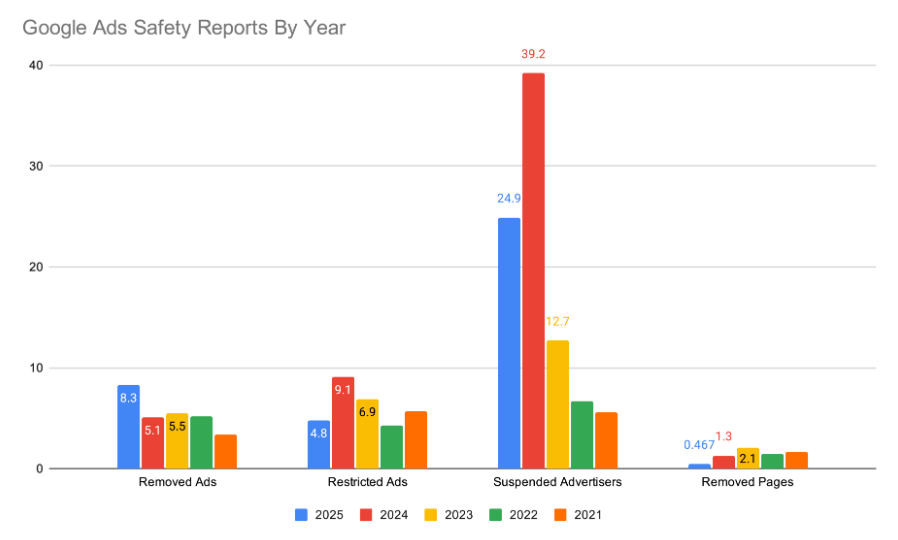
Source: Search Engine Roundtable
For advertisers…
Most advertisers who had an ad restricted or an account suspended in 2025 likely knew they were in contravention of Google Ads’ policies or broader legislation. But based on the broad range of reasons for penalties (see the table below), it’s reasonable to assume some simply made a mistake or didn’t fully understand the policies or laws at play.
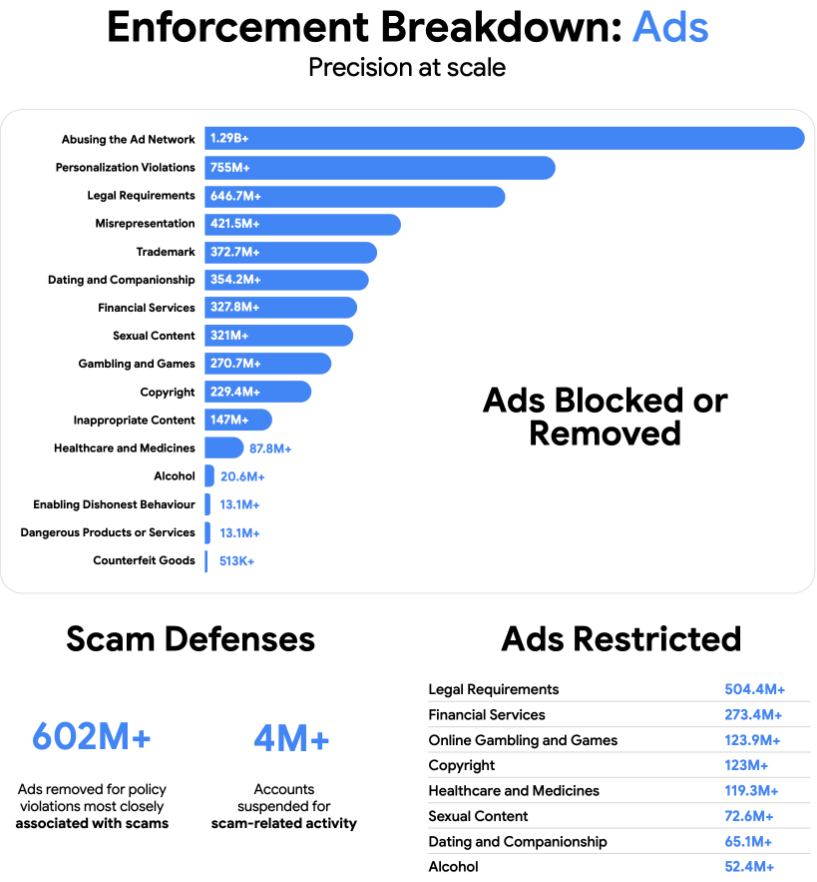
Source: Google
Google claims that Gemini 'reduced incorrect advertiser suspensions by 80%’ in 2025, which is great, but also means there’s still plenty of room for error.
Working with a Google Ads PPC agency, like TDMP, that understands your specific industry ensures your campaigns are both compliant and highly effective. Request a free PPC audit today.
🔴 Google AdSense testing new ad tech partners
Google has reported that it will be updating the default list of “commonly used” Ad Technology Providers (ATPs) available to AdSense publishers. The refresh is designed to ensure all approved vendors meet current privacy requirements and reflect genuine, active demand across the ecosystem.
Google has been testing the revised list with a subset of publishers, with a wider rollout expected from early June 2026. Once live, the update will influence how consent is collected and shared under GDPR and UK privacy rules.
For advertisers…
This change does not affect core delivery or bidding, but it can limit the effectiveness of third‑party tools layered on top of your campaigns.
When a vendor is not included on Google’s default ATP list, any AdSense publisher using Google’s automatic settings will stop passing consent signals to that vendor for UK/EU traffic.
This means that:
-
Retargeting may be disrupted if your audience partner can no longer receive consent from AdSense inventory
-
Attribution and verification may lose coverage if your measurement vendor is not on the updated list.
- Audience modelling or enrichment may weaken where data partners depend on publisher‑side consent signals.
🔴 Google consolidates Ads & Analytics data controls
Google has announced upcoming changes to how Google Ads and Google Analytics manage shared data. The goal is to remove duplicated settings and ensure that data is governed by the platform where it’s actually used.
For linked properties, Google Ads will control all Ads‑related data (including data coming from GA), while Google Analytics will control data used for Analytics reporting.
The first changes begin 15 June 2026, with further updates to ads personalisation and IP handling later in the year.
What these changes mean in practice:
- Consent Mode becomes the single point of truth for whether Ads identifiers, cookies, and GA‑sourced data can be used for advertising.
- GA settings will no longer override Ads behaviour, reducing the risk of mismatched consent configurations between platforms.
- Audience building and measurement that rely on GA data will depend entirely on Ads‑side consent signals, not GA’s internal toggles.
- If ad_storage is denied, Ads will not access identifiers, which may limit remarketing, modelling, and attribution - but this is already how Consent Mode works today.
For advertisers…
The key takeaway here is that you should check your Consent Mode implementation is correct, because it will soon govern both Ads and Analytics‑sourced advertising data.
🟡 Vignette ads setting may violate new back button hijacking spam policy
When running vignette ads with the ‘Allow additional triggers for vignette ads’ setting enabled, an ad may be triggered when a user navigates backwards using their browser back button on Chrome, Edge, or Opera.
This is now a violation of Google’s new back button hijacking spam policy.
For advertisers…
If you use vignette ads, we highly recommend toggling this setting off before the June 15th enforcement, to avoid penalties - and to improve the overall user experience of your site and ads.
To turn the problem setting off, follow these steps:
- Log In: Sign in to your Google AdSense account.
- Navigate to Ads: In the left-hand navigation menu, click on Ads.
- Edit Your Site: Locate your website in the table of sites, and click the Edit icon (the pencil button) next to it. This will open the ad settings preview of your site.
- Access Overlay Formats: In the right-hand panel under "Ad settings," look for the Overlay formats section and click on it.
- Open Advanced Settings: Scroll down under the Vignette ads option and click on Advanced settings to expand the menu.
- Uncheck the Trigger Box: Scroll to the bottom of the advanced options and uncheck the box that says: “Allow additional triggers for vignette ads”
- Apply Changes: Click the Apply to site button at the bottom right to save and push the updates live.
Important Note: Disabling this setting will turn off all additional vignette triggers (including triggers for page inactivity or scrolling back up), reverting your vignettes back to only triggering when a user naturally navigates between pages on your site. Given the risk of a Google search manual action, this is the safest and most user-friendly choice.
🟡 Google transitioning Dynamic Search Ads to AI Max
Google has confirmed that Dynamic Search Ads (DSA) will begin automatically upgrading to AI Max starting in September 2026. AI Max has been in beta for several months and is now moving into full rollout, with Google encouraging advertisers to migrate manually ahead of the auto‑upgrade for greater control.
AI Max introduces several enhancements over traditional DSA:
- Automatically created assets (ACA): AI‑generated headlines and descriptions, with optional text guidelines to keep messaging on‑brand.
- Campaign‑level broad match → AI Max: Broad match settings will be upgraded as part of the transition.
- Unified ad groups: Keywords, landing page targeting, and assets now live together in a single workflow.
- Brand & location controls: Available at the ad‑group level for tighter governance.
- Improved reporting: More granular asset‑level and search‑term insights.
For advertisers…
This transition is mandatory; the only choice is when you move. We recommend migrating early so you can:
- Review and refine automatically created assets
- Set brand and text guardrails before campaigns go live
- Restructure ad groups if your current DSA setup is fragmented
- Validate landing page coverage and targeting signals
- Monitor performance shifts before the September auto‑upgrade
If you rely heavily on DSA, treat this as a structural change rather than a simple feature update. AI Max behaves differently, uses broader signals, and will require fresh oversight once live.
🟢 Google Ads now records AI Lead Calls by default (Canada and US only)
In the US and Canada, Google is shifting call‑based conversions from duration thresholds to AI‑evaluated call recordings, aiming to better identify real intent signals, such as asking about services, booking an appointment, or expressing readiness to buy.
When call recording is enabled, Google analyses the conversation and only counts qualified calls as conversions. If recording isn’t available, Google falls back to duration, and in rare cases, ad‑interaction data.
For advertisers…
If this comes to the UK, it should give advertisers cleaner, more accurate lead data, especially for service‑based businesses where call quality matters more than call length. However, there are a few practical considerations:
- You’ll need call recording enabled, which means handling consent requirements that vary by region.
- Customers may be sensitive to recorded calls. Google plays an automated message informing callers that the interaction is being recorded, so transparency isn’t an issue, but some customers may find it invasive and off-putting.
- Industries with strict privacy rules (legal, healthcare, financial services) may need additional review before adopting this.
- AI isn’t perfect, so early monitoring is important to ensure conversations are being classified correctly.
- Conversion numbers may shift, not because performance changed, but because measurement did.
🟢 Microsoft Advertising adds new AI‑driven commerce & targeting features
Microsoft has rolled out several AI upgrades across its advertising and commerce ecosystem, including AI Max and improved visibility into how AI systems interpret your site via Clarity’s AI insights.
For advertisers…
In the right hands, these tools can give campaigns a meaningful lift through better targeting, cleaner insights, and more efficient optimisation. If you want support making the most of Microsoft’s growing AI capabilities, our PPC team can help you put them to work effectively. Learn more about our Paid Media services.
🟢 Microsoft adds conversion & spend metrics to PMax website publisher URL report
Microsoft Advertising has expanded the PMax Website Publisher URL report to include conversion and spend metrics, giving advertisers clearer insight into which placements are actually driving value.
For Advertisers…
This added visibility can help refine optimisation, from identifying high‑performing placements to excluding poor‑fit ones and reporting with more confidence.
Stay current with TDMP
As search continues to evolve, staying ahead requires adapting your strategy to match how platforms are changing in real time.
If you’d like help navigating any of these updates, whether it’s strengthening your SEO foundations, refining your paid media approach, or building visibility in AI-driven search, TDMP can help. Let’s talk.
Explore our previous 2026 roundups: