

For years, Google Search Console has provided a crucial window into website performance in Google Search. But as Search becomes more generative, its relationship with websites is becoming more complicated.
Through Search Console, Google is now giving website owners more visibility into these generative experiences, alongside new controls over how Google’s AI search features can use their content. But this appears to be just the beginning.
Here, we discuss what could be in store for website owners in Search Console.
A better understanding of AI visibility
Google’s latest addition to Search Console was Platform Properties, tracking how social content performs across Google Search, Discover and News.
As this is the first time Search Console has reported on search performance for content that isn't hosted on a website, it’s a notable shift. However, we don't expect this to be an area of significant expansion in the immediate future.
Where we do expect some movement is in the Search generative AI performance reports.
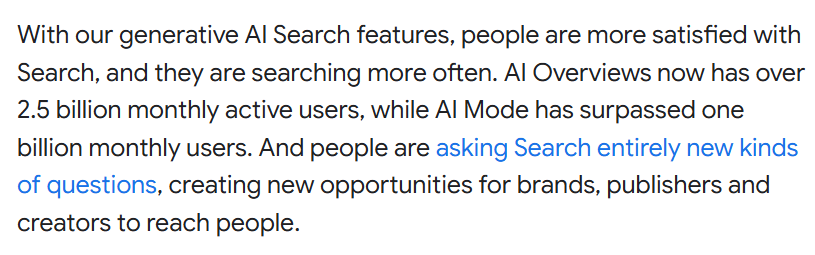
According to Google, its AI features are seeing more use than ever:
Source: Google
This means understanding visibility within these features is increasingly important. But the metrics that matter in AI search aren't necessarily the same as those traditionally used to measure website performance.
Related - AI visibility - What’s changed and what we’re doing about it
And Google appears to recognise this, having been clear about its intention to expand the data in Search Console’s AI performance reports:
‘We’re continuing to work with website owners to understand what insights will be most helpful to inform their strategies, and we’ll introduce additional metrics over time.’
Click data would be the holy grail, giving website owners a much clearer picture of how many visits are generated by AI Overviews or AI Mode, while also backing up Google’s claims against the zero-click phenomenon.
But there could be several stepping stones along the way:
Grounding queries
The underlying queries an AI system uses to find the different pieces of information it needs to construct a response to a user's original query.
Seeing these could give you a better understanding of the specific information your content is being used to help answer, beyond the user's initial search.
Themes or approximate search queries
AI search queries are getting longer and more varied, so search volumes for particular wordings are potentially too low to surface individually in Search Console.
A workaround could be to group similar queries broadly by theme, or more tightly using approximate queries that represent multiple searches around the same topic and with a similar intent.
This could give businesses a more representative picture of the search demand and AI visibility around a particular subject or subtopic.
Citation type
There are different ways for a website to be cited within Google’s AI-generated responses, and some are likely to be more useful for driving traffic than others.
Knowing whether your content is appearing as an inline link, a supporting citation or another type of reference could give businesses a better understanding of the quality of their AI visibility, rather than simply knowing that they've been cited.
However, Google frequently updates its citation approach:
‘Looking ahead we’re continuing to experiment with a range of new link designs in our AI experiences to make them more useful.’
This impermanence could make reporting on citation type difficult.
Share of citations
This would tell you the proportion of AI responses within a particular topic or query set where your website is cited, giving you additional performance context. For example, an increase in citations for a query set may look good, but if the query set is expanding faster than your citations, your overall citation share could be decreasing.
Engagement beyond clicks
Clicks are likely to remain an important measure of AI visibility, but they won't necessarily capture every meaningful interaction with a website's content.
A user might engage with a citation, expand a source or interact with an AI response without ever making it through to the website. More detailed engagement data could therefore help businesses understand the value of their visibility beyond simply counting impressions or visits.
Following its designation of Google under the UK's digital markets competition regime, the Competition and Markets Authority (CMA) mandated that Google provide publishers with detailed metrics on user engagement inside generative AI features. This legal pressure makes expanded interaction reporting in Search Console more likely.
More control for website owners?
Google's new Search generative controls are now available globally. They allow you to stop AI Overviews and AI Mode from using and citing your content. This comes after the CMA introduced its publisher conduct requirement designed to give publishers more choice and transparency over how their content is used in Google's AI features.
However, the existing requirement already goes beyond a simple yes-or-no choice. It covers publishers' ability to withhold content from AI training and grounding, with controls that can operate at directory and page level.
Future controls may therefore allow publishers to specify different rules for different types of content or areas of a website, or distinguish more precisely between uses such as grounding, training and other AI applications. In theory, these would be like the controls Cloudflare is currently developing for website owners.
Google is also piloting a contribution scheme through which website owners will be paid when their content is used to form the summarised answer in AI Overviews, AI Mode, or Gemini. The scheme is currently running through Search Console for the handful of publishers taking part in the pilot.
Based on what's known about the pilot, if it becomes standard, you would opt in to the contribution scheme via Search Console, then be able to view 'Monthly earnings' in a dedicated panel. But this might be a long way off yet.
TDMP - Clear reporting that keeps pace with Google
As new metrics become available in Search Console, TDMP will assess what they mean for organic performance and incorporate the valuable data into our reporting, ensuring clients have a robust understanding of website performance in Google’s AI search features.
Want to understand what AI search means for your website? Let’s talk. We can help you find opportunities in the challenges presented by a shifting search landscape.