

The latter half of September brought us a new Google spam update, a new Search Console filter, and multiple new AI search feature developments - so there’s plenty to discuss!
Updates are colour coded by importance:
🔴 Major developments likely to impact strategy
🟡 Worth watching or understanding
🟢 Informative - but lower impact for most
SEO
🔴Google September 2026 spam update launched
Google launched the September 2026 spam update on the 23rd of September, sharing that it should take a couple of weeks to fully rollout.
As with the previous spam updates of 2026 (this being the fourth), it’s a global update impacting all languages. No special focus has been announced, but some types of spam may be disproportionately impacted. More will be known once the update is completed and the effects can be analysed in full.
One clue as to where we might see the most impact is a recently published Google research paper. The paper, published around the same time the spam update was launched, details (vaguely) a new AI spam detection system called Scaled Abuse Forensics Examiner - or SAFE for short.
Not much is revealed across the paper’s 3 pages, but what’s clear is that SAFE has already been deployed and that it takes a comprehensive approach to AI detection.
It uses specialist AI agents to investigate various indicators of AI usage, from content analysis to network infrastructure.
Instead of just checking whether text "looks AI-generated," SAFE focuses on:
- Synthetic artefact detection: Analyses multimodal content (text, images, video) for subtle generative patterns and policy violations, including content that attempts to bypass basic AI classifiers but violates the intent of search guidelines.
- Inorganic behaviour recognition: Hunts for unnatural user activity and publishing patterns, such as sudden bursts of automated posting, fake engagement signals, or botnet interactions.
- Network & infrastructure cluster analysis: Traces the relationships between different accounts, domains, and hosting infrastructure to uncover coordinated spam networks rather than isolated sites.
You should only be hit directly by this update if your website is found to be breaking Google’s spam policies, but there can be wider turbulence as demoted or removed websites/pages leave vacuums in the ranks.
We’ll be covering the September 2026 spam update in detail in our live history of major Google updates.
🔴 AI Overviews further cannibalises Google Business Profiles
Google’s AI Overviews have been stealing engagement from Google Business Profiles (GBP) for some time now. We’ve reported on it several times:
- Are Google Business Profiles worth optimising in the age of AI
- Understanding recent Google Business Profile updates
- Mid-December 2025 Search Industry Updates
Now, it appears Google is pushing AI Overviews even further into GBPs’ territory. An Overview may present a full breakdown of your business, covering history, leadership, specialties, various site links, and all the classic GBP CTA buttons, e.g. ‘Call’, ‘Directions’ ‘Website’ ‘Share’, etc.
These overviews end with a ‘See more’ button that opens an AI Mode search rather than your GBP.
For business owners…
This means your GBP performance metrics could dip even further from pre-AI Overviews standards. Importantly, this doesn’t mean that your actual visibility is down; it’s just that the engagement is happening within an AI Overview instead of your business profile.
Also crucial to note - Google Business Profiles are still vital. They serve as a key source of information for Google’s AI search features, along with other online directories.
This means maintaining your GBP remains essential - but, as we discuss in our above-listed guide, ‘Are Google Business Profiles worth optimising in the age of AI’, what constitutes effective optimisation has changed.
As part of your local SEO campaign, TDMP can optimise and maintain your Google Business Profile, as well as monitor other important directories to ensure Google serves accurate information about your business for relevant search terms. Learn more about our SEO and local SEO services.
🔴 Information agents now freely available in AI Mode
Information agent search monitoring is now available to all AI Mode users. We reported on this feature back in June, when it was only available for AI Pro or Ultra subscribers.
In a nutshell, you can now ask AI Mode to continuously search for information online. When it finds what you're looking for, it sends you an alert via the Google app and your email.
For example, if you’re waiting for an anticipated product drop you know will sell out quickly, you can ask AI Mode to monitor for the stock landing. When it does, AI Mode sends the alerts, and you can make a swift purchase.
For website owners…
As we noted in our June coverage, this semi-agentic functionality has some implications for SEO, particularly when it comes to ecommerce stock monitoring, but the impact reaches beyond retail.
For service-based businesses, B2B companies, and content creators, it creates a new layer of potential discovery:
- Tender & procurement monitoring: B2B buyers and organisations can instruct agents to track when you publish new service offerings, RFPs, or pricing updates.
Content & thought leadership alerts: Prospects or industry peers can set agents to ping them the moment you publish a whitepaper, announce an event, or launch a new case study. - Competitor & market intelligence: Competitors and market analysts may use these agents to passively track your company news, media coverage, or other updates.
To capture traffic from AI information agents, website clarity is essential. If your key updates, launch announcements, or service details are buried inside unindexed PDFs, complex script-heavy pages, or ambiguous copy, these automated agents may not be able to parse the data, and your prospective clients won't get the alert.
🟡 Multimodal search filter coming to Search Console
Google is rolling out a multimodal search filter to Search Console. This reporting shows you which pages are reached via image-based searches (Lens, Circle to Search, etc.).
Despite ‘multimodal’ implying a potential textual or voice element to a search, no query data is given, so you can basically just think of this as an image search filter.
For website owners…
Despite the lack of query data, this could be helpful.
It can show you which of your pages are performing well specifically for image-led search. You can then assess what’s working for those pages and apply your learnings elsewhere to increase traffic across other key pages.
Lens is a major search pathway, so there could be some real value in these optimisations.
According to Google, Lens handles over 25 billion queries per month, and they also suggest 1 in every 5 of these Lens queries has commercial intent. Do note, however, that this applies mostly to product-based shopping, as it’s image-led.
That said, camera-first search is increasingly relevant for service businesses too. For instance, searchers may search using photos of broken parts, error codes on equipment, specific vehicle components, or photos of local venues and facilities to find service providers who can fix or support them.
🟡 Google’s AI Contribution pilot pay rate revealed
In our mid-September search industry roundup, we discussed Google’s AI contribution pilot, which is testing paying publishers each time their content is used to inform AI-generated answers across AI Overviews, AI Mode, and Gemini.
The price Google was paying for content use was unknown, even to publishers taking part. Now, it has been reported that, through this scheme, publishers are receiving roughly 0.1% of their ad revenue.
For example…
The baseline: Imagine a mid-sized digital news site or blog that makes $1,000,000 a year running display ads (like Google AdSense, Mediavine, or direct ad banners) on their site.
The 0.1% payout: Receiving one-tenth of 1% means Google’s AI pilot program is paying that publisher roughly $1,000 per year.
For website owners…
Simply put, the money Google pays publishers via this pilot is only a fraction of the ad revenue those sites lose when AI answers keep searchers from clicking through.
It’s better than nothing, but revenue is still harmed in a very real way by Google’s AI search features.
🟢 Google testing in-line links to AI Mode from AI Overviews
The linking situation in AI Overviews has been comparatively healthy for a while, but Google is tinkering again, and not in a good way.
Related - Evolution of AI Overviews - A stage-by-stage breakdown of real-world search impact (2023-2026)
It seems they're testing placing in-line links within AI Overviews that direct the user to AI Mode rather than a website.
For website owners…
It’s not that website links are now less prominent or frequent in AI Overviews, so that’s good - you can still win that valuable visibility at position zero.
However, these links are now competing with quite prominent explore-more type links at the bottom of the overview:
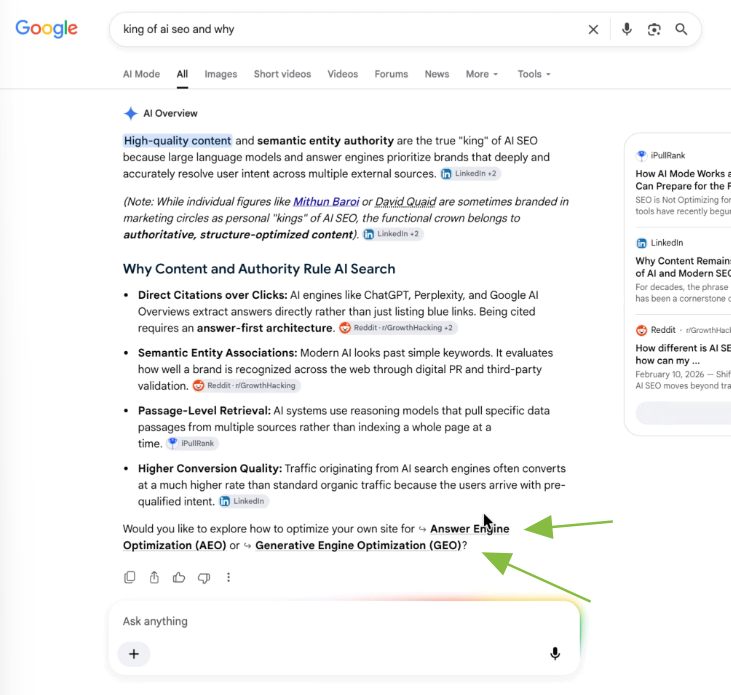
Source: X
As mentioned, this is just a test. It might not stay this way.
🟢 Automatic opening hours setting in Google Business profile
Google is testing a new feature in Google Business profile to make managing opening hours easier. You describe your opening hours once, then, using AI, Google puts them into a structured format that can be listed on your local panel.
For businesses…
This is a micro-efficiency boost, but it all adds up. For multi-location businesses currently dealing with click-heavy dropdown menus across multiple listings, it could result in meaningful time savings over the course of a year.
🟢 Verified contact information now permitted in Google Posts
Google has updated its Google Posts help documentation for GBP owners. The adjusted document states that you can now include contact information (phone number, email address, social handles) in the updates you post to your profile.
But these contact details must match the details in your business profile. If they do not match, then the post will be automatically removed.
Previously, contact details were not permitted in posts due to the potential for fraud, but Google has eased that rule while maintaining fraud protections through the verification requirement.
For businesses…
This update can help you capture leads directly from Google’s AI search features when you're promoting a special offer, event, or department. Including contact details in your posts gives AI models fresh, contextual signals to use when building direct answers for searchers.
Here’s why this matters:
- Your main GBP number answers: "How do I reach this company in general?"
- Contact info in a Google Post answers: "How do I reach someone regarding this specific offer, event, or department right now?"
Google's AI can then pick up on that fresh context to offer highly specific guidance in search results.
Here’s an example in practice: An auto centre posts: "Emergency breakdown and MOT slots available this Saturday—call 0161 496 0123." (This is one of several verified lines on their Google profile).
A user searches: "Who can I call in Manchester for an urgent Saturday MOT?"
Google’s AI search features can instantly identify the relevant post, cross-reference the phone number against the verified business profile to ensure it’s legit, and present the direct phone number straight to the searcher.
Paid Media
🟡 Dedicated AI Max reporting coming to Google Ads
Google Ads is launching a unified reporting feature for AI Max campaigns that consolidates search terms, ad creative, and landing pages into a single end-to-end view.
Previously, tracking this user journey required manually cross-referencing three separate reports. Advertisers can now see the exact search query typed, the specific AI-generated ad headline shown, and the landing page the user reached in one place.
For advertisers…
This visibility gives marketers insight into how campaign automation functions in practice. By viewing queries, creative, and landing pages side-by-side, teams can identify performance disconnects (such as mismatched AI headlines or irrelevant landing page routing) and quickly apply negative keywords or URL exclusions without relying on broad campaign-level averages.
Operations-wise, the consolidated data offers an objective way to evaluate whether AI features are driving high-value traffic or inefficient clicks.
Instead of relying solely on top-level metrics like aggregate ROAS, you have more concrete, line-item evidence to demonstrate campaign performance to clients and stakeholders or justify tighter manual guardrails where needed.
🟡 Google Ads to show competitor spend data
Google ads is reportedly rolling out what they’re calling a ‘Spend Benchmark Report’ that tells you how your spend compares to that of businesses it thinks are similar to your own. It also shows you how this difference in spend impacts clicks, comparing how many clicks your ads received vs the similar business.
For advertisers…
While this seems very useful on the surface, it could also be misguiding. Google doesn’t know who your actual competitors are, so be careful when using these insights as a basis for adjusting your campaigns.
Google claims that they select the competitor based on industry and the locations they’re targeting with their ads. Those things alone don’t determine a direct competitor.
Furthermore, even similar businesses within the same industry are most likely working with different margins and could have completely different goals for their paid media.
So if these insights seem to show that your “competitor” has an edge on you, it might not actually be the case.
These benchmarks also insinuate that the only factor that influences clicks is spend. While spend is important for scaling, it’s not the only factor that determines performance. With this in mind, increasing your spend to match or get closer to the competitor benchmark might not result in the expected rise in clicks.
If these benchmarks were to become a bit more detailed, they could have real value, but for now, it’s best to take them with a pinch of salt.
Optimisation should instead be guided by your campaign performance assessed against your paid advertising goals. TDMP’s award-winning Paid Media team can ensure every penny of your ad spend has an impact and works towards better outcomes. Learn more about our PPC services.
🟢 ChatGPT gets conversational ad agents
OpenAI is testing “Sponsored Agents” in ChatGPT. These serve as a secondary engagement layer of an ad served during a ChatGPT interaction. You can think of them like customer service chatbots attached to ads rather than your website.
Here’s how the process would play out:
- User clicks on an ad served during their interaction with ChatGPT
- A new chat loads with the Sponsored Agent
- The user can interact with the agent as it would ChatGPT, asking questions about the advertised service, product or business
- The agent responds and provides relevant options and links
And below is a visual example of the process:
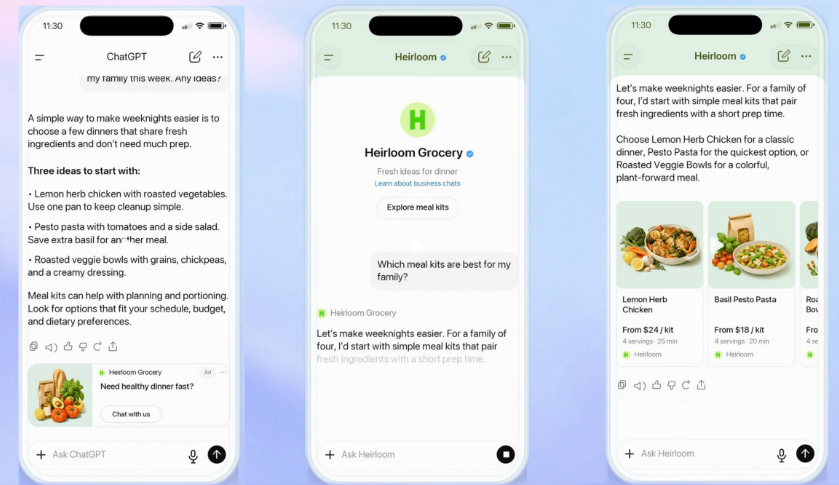
Source: SEO Roundtable
Stay current with TDMP
Search is evolving in big and little ways every day. We cut through the noise and flag the most important developments to keep you informed, but staying current is only the start. If you need support navigating the changes discussed in this roundup, contact TDMP today.
We specialise in Search Everywhere Optimisation and Paid Advertising, helping a broad range of clients build visibility, tap into opportunities, and grow their business.