

The latter half of June, while not as consequential as the first, brought several important search developments.
For instance, Google hit us with yet another algorithm update, and the CMA hit Google with new conduct requirements that could give UK businesses a helping hand with their digital strategies.
Updates are colour coded by importance:
🔴 Major developments likely to impact strategy
🟡 Worth watching or understanding
🟢 Informative - but lower impact for most
SEO
🔴 Google June 2026 spam update launched and completed
Google’s latest algorithm shift was a spam update launched June 24 and completed just two days later on June 26.
No new spam policies have been introduced since the April back button hijacking policy, so this update was aimed at better filtering out existing types of spam from Google’s SERPs.
We have begun our detailed coverage of the June 2026 spam update on our live history of major Google updates - and will continue to add information as it surfaces or as we observe it in our own data.
If your site has been hit by the June 2026 spam update, or if you are still trying to recover from an earlier change to the algorithm, we can help. Contact TDMP today to take back control of your search performance.
🔴 CMA orders Google to provide greater ranking transparency
Under the UK’s Digital Markets Competition Regime, the Competition and Markets Authority (CMA) has announced two new conduct requirements for Google.
One orders Google to provide UK businesses with greater transparency into how their ranking systems work. The search giant has also been ordered to give advanced notice of any significant changes to their algorithms.
The CMA has set a timeline of 6 months for Google to submit its search ranking algorithm.
Additional stipulations encompassed by this order state Google must also:
- ‘Rank ‘organic’ search results using objective and non-discriminatory criteria (including in AI Overviews but not sponsored results)
- Introduce clear processes for businesses to raise concerns about how Google ranks results and have them addressed effectively’
The second of the conduct requirements forces Google to provide third-party companies with user search data (where consent is given) to help them refine their services and targeting.
For marketers…
Conclusive information on Google’s ranking factors sounds like a dream come true for UK marketers, but we’d advise against getting your hopes up. Google has been asked to reveal their ranking secrets by governing bodies before and are yet to do so in a meaningful way for businesses.
Unless the CMA provides extremely specific definitions of what they want from Google, it’s possible Google may get away with offering up very little new information. For instance, Google’s legal team may claim that they are already transparent about ranking, citing the generic advice they provide on a regular basis, e.g. write good, original content for humans and improve the user experience.
Still, any new insights into how Google’s ranking systems work will be valuable for those who understand how to respond to them with sharp digital strategy, which TDMP can help with. Learn more about our SEO service.
On the advanced notice front - Google’s John Mueller previously said that it wouldn’t be feasible to pre-announce updates for a fixed date.
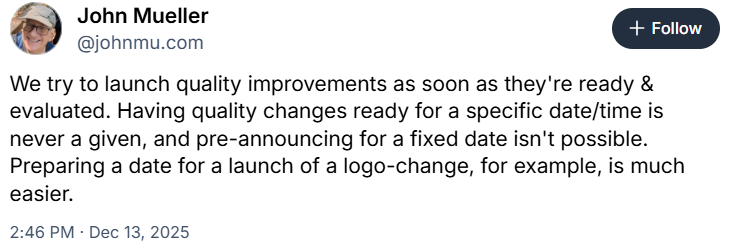
Source: Bluesky
This means Google may be required to give a rough “heads-up” when an update is nearing rollout-readiness, which could be helpful.
Prior knowledge of an algorithm update means UK businesses could:
- Audit websites ahead of time
- Plan for organic disruption by allocating budget towards paid advertising
- Raise concerns about aspects of the update before it goes live - depending on the level of details Google is willing to submit
🔴 Bing Webmaster Tools gets new AI performance reporting features
Eager to stay ahead of Google, on June 17, Bing announced a preview of several new AI performance reporting features in Bing Webmaster Tools.
The new features include:
- Intent - sorts the grounding queries, that result in your website being cited, into intent buckets:
- Informational
- Commercial
- Navigational
- Learn & Solve
- Research
- Creation
- Local
- Live Event
- Comparison
- Topics - Helps you understand the broader topics your pages are being cited to support by grouping related grounding queries by theme.
- Citation share - The percentage of all citations related to the grounding query that are attributable to your website.
- Compare - Allows you to directly compare two time periods rather than observing them in isolation.
For website teams…
These are great additions to the reporting. Here’s how they help:
- Intent tells you exactly when you are visible in the buying journey. Knowing whether you are reaching users who are just browsing (Informational / Research), ready to buy (Commercial), or looking for a specific tool or guide (Learn & Solve / Creation) shows if your content strategy matches actual user behaviour.
- Topics helps you see the "big picture" of what search engines think your site is an authority on, allowing you to quickly spot new content gaps or identify broad thematic areas where your visibility is dropping.
- Citation share is a broad measure of your dominance in AI search, helpful for tracking improvements over time. However, because it lumps all other websites into a single pool, it won't show you exactly which specific competitors you are winning or losing against.
- Compare makes it easier to track citation performance for set periods. It’s helpful for measuring the impact of a new content rollout, tracking seasonal traffic shifts, or proving to stakeholders that your AI visibility is growing month-over-month.
Some speculate that both Google and Bing’s reluctance to share click data from their AI surfaces is that it will show objectively that AI is reducing clicks, which is what recent studies (as well as the industry’s observations) seem to suggest.
See possible reasons why zero-click searches are more common in the UK.
🟢 GSC AI performance reports expanding beyond the UK
Following the beginning of the UK rollout of AI performance reports in Search Console, Google is expanding access to more nations, including India and Switzerland.
Rollout is ongoing in the UK.
Not seeing these reports in your Search Console yet? You can check exactly what they do and do not tell you in our dedicated guide.
🟢 Bing Webmaster Tools may expand country filter
In response to concerns about Bing Webmaster Tools only showing data for 10 individual countries (with others lumped into ‘Rest of the World’), Bing is considering adding more countries to the filter.
For marketers…
This is handy if you’re targeting a country outside of the 10 currently provided:
- UK
- Germany
- France
- Italy
- Spain
- Japan
- China
- Canada
- USA
Additional nations means you’ll be able to track performance on a far more granular scale, supporting faster and more data-driven marketing optimisations.
Paid Media
🔴 Google opting advertisers into conversion-based customer lists
As of June 17, Google has automatically turned on conversion-based customer lists for advertisers already using Enhanced Conversions and Customer Match. Data processing is set to start August 18.
Conversion-based customer lists are audience segments that Google Ads builds automatically using your website's real-time conversion events. Instead of requiring marketers to manually export and upload static CRM files, these lists live in your Audience Manager and dynamically update on their own as new conversions roll in.
For advertisers…
This automatically puts your first-party data to use, which can help improve campaign performance. However, allowing Google to automatically build these lists means the algorithm will guess and assign labels like "New" or "Existing" customers, which can skew Smart Bidding strategies if the system misclassifies your leads.
If you’re concerned about this feature, you can opt out before August 18 and give your team time to audit conversion tracking and control exactly how your first-party data is used.
🔴 Google Ads gets a security task summary to help advertisers protect accounts
Google has added a new ‘Summary’ tab to the ‘Access and security’ section of Google Ads. The new tab offers a summary of account security actions taken and those yet to be implemented.
The actions include:
- Creating a passkey
- Reviewing domains
- Reviewing users
More options may become available over time, as Google has been actively working on extra security steps for Ads accounts.
Google Ads account hijackings have been on the rise as of late. This addition should help advertisers stay on top of security and close vulnerabilities.
For advertisers…
You may not see the summary tab in your account just yet. When it surfaces, we recommend checking it periodically to ensure all security measures are in place or included as part of your account maintenance process.
🟡 Google Ads gets ‘Unique search category’ data columns
Google has introduced 3 new data columns in Google Ads:
- Unique search categories with clicks
- Unique search categories with conversions
- Unique search categories with impressions
For advertisers…
This new data can tell you 2 key things:
- High impressions / low clicks or conversions: If you have 100 unique categories getting impressions but only 2 getting conversions, your broad match keywords are wasting budget across irrelevant themes.
- High conversions concentration: It highlights exactly how many distinct thematic buckets are actually driving your revenue, making it easy to identify new, high-performing keyword categories you may consider building dedicated ad groups for.
🟡 Google Ads requests verification for financial advertisers across 24 European markets
In order to crack down on dicey financial services ads, Google is expanding verification requirements for financial advertisers across 24 nations in the European Economic Area (EEA).
These nations are as follows: Austria, Belgium, Bulgaria, Croatia, Cyprus, Czechia, Denmark, Estonia, Finland, Greece, Hungary, Iceland, Latvia, Liechtenstein, Lithuania, Luxembourg, Malta, Netherlands, Norway, Poland, Romania, Slovakia, Slovenia, and Sweden.
Certain financial advertisers serving the covered nations now have to prove they are authorised by national regulatory bodies, seek G2 verification, and then apply for Google verification.
It doesn’t apply to all categories of financial services advertising, but Google provided the following non-exhaustive list to build a better understanding of who may fall in scope:
- ‘Banking
- Credit cards
- Credit and loans
- Investment
- Brokerages and day trading
- Bonds, commodities and future trading
- Insurance'
For advertisers…
For advertisers in scope, verification is essential to maintaining campaign performance. Google aims to let those affected know via in-account notifications.
Once notified, you have 30 days to complete the verification process. You will not be allowed to show financial services ads in the targeted EEA countries until verification is fully completed. Affected campaigns will effectively be paused or restricted from serving.
If your business relies on an agency or an approved third-party partner to run your ads, they cannot apply for you independently. The authorised first-party business must obtain the verification first, or your external campaigns face the same restrictions.
Verified but campaigns underwhelming regardless? We’re an award-winning PPC agency with a proven track record of delivering exceptional results in highly regulated markets such as finance. Explore our PPC services.
Stay current with TDMP
In an industry that moves so quickly, staying informed about the big developments is essential to reaching your potential in digital. If you need support navigating any of the changes discussed here, TDMP can help.
We’re an award-winning digital marketing agency with a focus on data-driven strategy, helping businesses stay ahead in search as the landscape shifts. Contact us today to request a free SEO or PPC audit.
Explore our previous 2026 roundups: