

With a new broad core update, a reimagined Google search bar, and several platform developments, May was an incredibly busy month in Search.
We’ve gone through everything, filtered out the noise, and shortlisted the updates most likely to matter to your digital strategy.
Updates are colour coded by importance:
🔴 Major developments likely to impact strategy
🟡 Worth watching or understanding
🟢 Informative - but lower impact for most
SEO
🔴 Google May 2026 broad core algorithm update launched and completed
Google announced the May 2026 core algorithm update on May 21st. It rolled out over just shy of 12 days, wrapping up on June 2nd.
Judging by the scale of rank volatility, it was a larger update than its March predecessor.
As a broad core update, it has no particular focus, instead assessing all content types, although impact patterns may surface once widescale analysis takes place. We’ll be covering this algorithm shift in detail over on our live guide to Google’s major updates once the dust settles and more is known.
If you need support navigating Google’s algorithm updates and broader changes in Search, TDMP can help. Explore our SEO services.
🔴 Microsoft Clarity gets an AI citations report
Microsoft has announced that AI citations data has been added to the AI visibility reporting in their web analytics tool. It provides insight in the following areas:
- Page citations: number of times your content was referenced in AI outputs
- Share of authority: percentage of total citations attributed to your domain in comparison to other domains cited in the same query sets your content appeared for
- AI referral traffic: number of sessions on your website that were referred from AI search assistants
- Queries: sub-queries AI systems search that resulted in your content being used in an output
- My cited pages: URLs in your domain that are cited in AI-generated responses. Includes associated grounding queries
- Trendlines: how activity changes as AI systems and your content change over time
For website owners…
Insights that have until now only been available in specialist tools are becoming accessible for all. CTR data is still missing from these new reports, but this might come sooner than expected now that Microsoft and Google are forcing one another’s hand to provide more and more AI search insights in their analytics solutions.
After stirrings in April, Google has now officially begun rolling out AI performance reports in Search Console. We’ll be posting a dedicated article on these reports shortly.
🔴 AI traffic measurement could be coming to GA4
Google shared in their most recent ‘What’s new in Google Analytics’ post that they’re launching an ‘AI Assistant traffic measurement’ in GA4.
According to Google, this new feature would provide a way to measure and analyse traffic from popular AI assistants. As examples of "popular AI assistants”, the post offers ChatGPT, Gemini, and Claude. It doesn’t mention AI Overviews or AI Mode.
It also doesn’t appear as though the feature will distinguish between AI traffic sources, instead applying a blanket ‘ai-assistant’ or ‘AI Assistant’ value or label.
For advertisers…
Rollout of AI Assistant traffic measurements could be quite a drawn-out process, as not many GA4 users are seeing it in their account yet.
When it does finally arrive, it’ll be a good way to gauge performance across the main AI chatbots, but without source differentiation, it's something of a blunt tool when it comes to optimising for visibility in AI-driven search.
If you need more detailed reporting, TDMP can help. We provide clients with regular, highly accessible search performance reports that include overviews of traffic from specific AI platforms and surfaces. Please get in touch to learn more.
🟡 Google testing protocol to reliably authenticate bot visits
Google’s Web Bot Auth is a cryptographic protocol that provides a reliable way for authentic bots, such as GoogleBot, to prove they’re legitimate. It can help website owners distinguish between automated visits from official sources and random scrapers.
Web Bot Auth is currently "experimental" and being tested locally by Google on some of the AI agents hosted on their infrastructure.
For website owners…
In theory, if the Web Bot Auth protocol becomes standard, you could see exactly which agents are hitting which pages, how often, and with what patterns. This means:
- You’d understand how search engines and AI agents were consuming your content, which could guide more reliable optimisations and inform the creation of new content
- You could spot crawl issues faster
- More accurately separate human from bot traffic
🟡 Google officially rolls out linking changes to increase clicks from AI surfaces
We covered Google’s testing of different linking approaches in AI Overviews and AI Mode in early 2025, but now they seem to have officially approved 5 additions to encourage clicks to the wider web.
1. You may now start seeing a defined ‘Further Exploration’ section at the end of an AI response, providing detailed, contextual snippets alongside blue links.
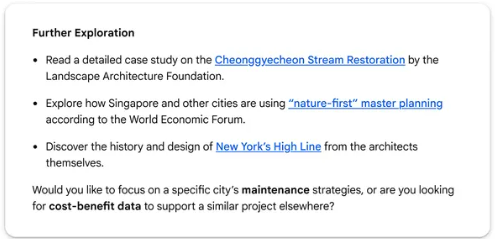
Source: Google
2. If the user has linked a news subscription to Google, and information from this preferred source is used in the output, Google will now label the link ‘Subscribed’ in the overlay.
3. Perspectives from online discussions across social media and other sources will now carry additional context, such as the creator’s name, handle, or community name.
4. More links will appear next to relevant text within responses.
5. Hovering over an in-line link will prompt a small preview window containing helpful information about the website or webpage, explicitly communicating relevance to the search.
For website owners…
This will likely increase clicks from Google’s AI surfaces, making it more important to build a presence in AI-driven search. Organic rank is still essential, but with high quality, informed clicks up for grabs outside of the traditional SERP, it shouldn't be your only concern.
This is just the latest in a long line of AI Overview developments. Get the full story in our AI Overviews timeline post.
Related - Are Google Business Profiles worth optimising in the age of AI?
🟡 Google rolling out a new search bar
Google is rolling out a new search bar for its main search page. While there have been several tests and small adjustments in the past, this marks the first major rethink since Google launched.
The new search bar, which Google refers to as ‘the intelligent search box’, introduces the following features:
- Expanding text space - the text field now expands dynamically to provide enough space for long, conversational queries.
- Multimodal capabilities - users can upload images, videos, files or even add Chrome tabs as inputs to inform the search.
- Enhanced autocomplete - AI-powered intent predictions help searchers formulate longer queries.
As per Googler, Liz Reid, at Google’s I/O event in May, the new search bar (or box) is rolling out to all countries (and all languages) where AI Mode is currently available.
For website owners…
In embedding such deep multimodal capabilities into the main search bar, Google is enabling users to search in more fluid, less predictable ways. Longer, more contextual queries that use mixed inputs may become more common. That means:
- Intent signals fragment — fewer clean keyword patterns. Complex multimodal journeys.
- Attribution weakens — as Google absorbs more context directly from the user’s device, fewer touchpoints pass through your site or analytics stack.
- Content strategy must broaden — not just rankable pages but assets that can be interpreted across modalities: structured data, high‑quality imagery, product files, and clearer semantic relationships.
- Technical SEO becomes more foundational — Google leans harder on entity understanding, schema, and content relationships when queries become less literal. Request a free technical SEO audit.
🟢 Google removes FAQ rich results from Search and reporting
As of May 7th, Google no longer serves FAQ rich results on their SERPs. There will, therefore, be no further FAQ rich result reporting in Search Console.
For site owners…
If you use standard Search Console, you don’t need to do anything other than prepare for a very slightly reduced SERP rich results report. If you have the markup for FAQ rich results implemented on your site, you don’t necessarily have to remove it, as Google and other search engines typically just ignore irrelevant schema, but you can if you want.
On the other hand, if you use the Search Console API, you will have to make some adjustments to ensure smooth API operation.
The Search Console API will serve FAQ rich results reports until August 2026. This gives you time to adjust your API calls to make sure your scripts, dashboards, and data pipelines don’t break when Google finally removes the FAQ‑related fields from the API response structure.
In terms of Search impact, there’s little to worry about. The reason Google has removed this rich result type is that it only showed for ‘a very small set of site types.’ Chances are your site wasn't triggering this rich result anyway.
🟢 Google AI Mode now powered by Gemini 3.5 Flash
Google has made Gemini 3.5 Flash the new default model for AI Mode globally. Gemini 3.5 Flash is action-focused, offering enhanced agentic capabilities - and is particularly proficient when it comes to coding.
This follows the recent rollout of a new AI Mode search experience for Chrome users - Find out what this new search capability means for marketers.
Gemini 3.5 Flash is also better at handling multimodal queries, meaning it can interpret combinations of text, images, and voice more precisely and better satisfy underlying user intent.
For site owners…
This shift pushes Google further toward agentic search, where the model doesn’t just answer but interprets, plans, and acts. By strengthening multimodal and alternative search responses, users may also increasingly use mixed inputs rather than text alone when searching.
🟢 ChatGPT sending 150% more traffic
While OpenAI’s most recent ChatGPT Instant model is hardwired to surface fewer links, their other models have gone in the other direction.
The platform has been including more brand links in its outputs, which has led to a 150% increase in referral traffic, according to a Similarweb study. Findings also suggest that page views per visit are up 24%, while time on site has risen by 11%.
Roughly 60% of traffic from ChatGPT landed on brand homepages, suggesting queries might be higher-funnel and not overly specific.
For brands…
While this is great news overall, it could be a temporary uplift. The comparison period was pre May 7th vs post May 7th, with the findings being published on May 22nd. So, this isn’t based on all that much data.
If the upward trend continues, it makes ChatGPT a more viable platform for brands to factor into their digital strategy.
Paid Media
🔴 Google Ads shortens retention period for granular data
Google has reduced the window for storing granular data on Google Ads. By granular data, they’re referring to hourly, daily, and weekly data (basically anything under a month). This will now only be held on-platform for 37 months. After this period, it will automatically be removed from both the Google Ads interface and the Google Ads APIs.
For advertisers…
If you rely on granular historical data, it’s important to export more regularly and consider how long-term trend analysis can be carried out off-platform.
🔴 Google Ads search terms report may show non-exact keywords
As Google’s AI search features encourage longer, more conversational, varied, and multimodal searches, including exact keywords in Google Ads search terms report isn’t always viable.
As a result, Google has added the following section to their ‘About ad group and asset group prioritisation within a Google Ads account’ document:
‘Advanced search experiences: In some cases, a user’s search may involve more complex search journeys, for example, searches on Lens, AI Mode, AI Overviews, or auto-complete searches. In these instances, the search term shown in your reporting represents the best approximation of the user’s intent. Because these searches are not considered technically identical to a keyword, keywords may not automatically be prioritised. Instead, AI-based ad group prioritisation ensures that the most relevant ad groups or asset groups are selected to match the user's overall intent.’
For advertisers…
This is reassuring, providing transparency in how Google Ads is handling the exponential expansion and diversification of modern Search.
It shows that Google is actively fine-tuning their systems to accurately calculate the true intent of the user, meaning ads are more likely to be relevant to the viewer no matter how complex the search journey.
However, it also means advertisers lose some precision. When Google reports an interpreted search term rather than the exact query, it becomes harder to see what actually triggered an ad, refine match types, or build effective negatives.
Optimisation becomes a bit more of a black box, with more trust placed in Google’s intent modelling and less in clear, keyword‑level signals.
Partnering with an experienced paid media agency like TDMP can help you stay in control of your campaign performance. Request a free PPC audit to see if you’re prepared for intent-led matching.
🟡 Google vignette ads will no longer trigger after back navigation
In our April roundup, we warned that the browser back button trigger for vignette ads is in direct conflict with Google’s new back button hijacking policy, and that using this setting could result in penalties.
Thankfully, the browser back button trigger will be removed as a potential additional trigger for vignette ads, ensuring no advertisers accidentally break Google’s spam policy.
For advertisers…
If you’re opted in to additional triggers for vignette ads, the back button trigger will simply not apply. This change is automatic, and advertisers do not have to change any settings in their AdSense account.
However, if you followed our previous instructions on opting out of additional triggers for vignette ads in order to avoid penalties, now that it is safe to do so, you may want to turn the setting back on. Here’s how to do it:
- Log In: Sign in to your Google AdSense account.
- Navigate to Ads: In the left-hand navigation menu, click on Ads.
- Edit Your Site: Locate your website in the table of sites, and click the Edit icon (the pencil button) next to it. This will open the ad settings preview of your site.
- Access Overlay Formats: In the right-hand panel under "Ad settings," look for the Overlay formats section and click on it.
- Open Advanced Settings: Scroll down under the Vignette ads option and click on Advanced settings to expand the menu.
- Check the Trigger Box: Scroll to the bottom of the advanced options and check the box that says: “Allow additional triggers for vignette ads”
- Apply Changes: Click the Apply to site button at the bottom right to save and push the updates live.
🟡 Google Ads launches new bidding feature, expands others
Google Ads has introduced journey-aware bidding in beta. This new bidding feature allows you to feed Google Ads’ AI conversion action data (beyond the conversions you're bidding to), giving it a better understanding of your customer journey.
In turn, this should help the AI to be more precise in its optimisations.
Google has also expanded Smart Bidding Exploration to Performance Max and Shopping campaigns, ‘helping you to capture less obvious queries that you weren’t able to win before’ - no targeting adjustments required.
And finally, Google Ads is upgrading budget pacing, enabling dynamic adjustments that aim to ‘keep pace with consumer behaviour and demand’.
🟡 Google Ads to automatically link to your YouTube channel
Google has notified some advertisers that Google Ads accounts will automatically be linked to the corresponding YouTube channel in order to pull in useful data and facilitate ads that target those who visit and engage with your channel.
The integration will add the following features to your Ads account:
- View counts: View organic - this will show non-paid-for view counts of your videos
- Data segments: Create data segments - As discussed above, this will allow you to create a remarketing list based on interactions on your linked channel
- Engagement: View earned actions metrics from video ads and use engagements - This will show you how viewers interact with your ads beyond the initial view, including actions such as likes, shares, new subscribers, and additional video views triggered by your ad exposure
For advertisers…
Google accounts will link to available YouTube channels automatically by June 10th, but you can opt out ahead of this date if preferred.
While this integration can be beneficial, some reasons you may think twice include:
- You don’t want Google Ads to access or use your organic YouTube engagement data
- Your YouTube channel is managed by a different team or agency
- You use multiple channels and prefer to control which one (if any) is linked
- Your organisation has strict privacy, data‑sharing, or compliance rules
- You don’t use YouTube in your advertising strategy and don’t need the integration
🟡 Google Ads adds new mode for targeting cold prospects
Prospect Mode is a new feature in Google Ads’ New Customer Acquisition toolset. It allows you to filter out any users who have purchased from you, searched branded terms, visited your website, used your app, or engaged with your content or ads on Google or YouTube.
For advertisers…
This new mode can help you in two key ways:
- You can avoid paying to show ads to people who are likely already in your funnel.
- You can launch aggressive brand awareness and growth campaigns primed to target new audiences only.
If finding truly new business is part of your 2026/27 strategy, Prospect Mode could make it easier to hit your targets. But we’d advise a controlled experimentation period before using it for more than one or major campaigns.
Test the waters with an individual campaign and compare performance against your existing setup. If you’re seeing results, scale up gradually from there, monitoring at each incremental shift to ensure it’s still working.
🟢 Google to expand paid ads in AI Mode
Google has provided three updates regarding the paid ad options in AI Mode:
- Shopping Ads in AI Mode - Google can now show the most relevant product with custom text explaining why it could be the right choice for the user
- Business Agent for Leads - A brand agent inside ads that can answer user questions and facilitate communications between the two parties
- Direct Offers (still in the pilot phase) will surface in AI Mode in one of three ways:
- Promotional bundling - where brands upload promotions to Google Ads and Gemini uses this information to construct a custom deal in real-time within AI Mode
- Native checkout - native integration for the UCP protocol, helping merchants secure sales directly in AI Mode
- Travel expansion - Google’s travel partners will be able to present special offers within a user’s ‘AI-assisted trip planning’.
For advertisers…
Google suggests these advertising options will be available in the coming months, and the US will get priority, so it’s unclear when the UK will have access to them.
They may signal a shift in how ads are matched, explained, and measured inside AI Mode. Expect reduced query visibility, heavier reliance on feed and creative quality, and wider attribution gaps as more of the journey happens inside Google’s interface.
Stay current with TDMP
With agentic search picking up steam and Google Ads releasing a constant stream of new features, there’s a lot to process to stay ahead in Search. But with the right agency support, you can confidently keep pace and stay in control of your digital performance.
If you’d like support navigating the complexities of Search, TDMP can help. Let’s talk.
Explore our previous 2026 roundups:
Or if you’re in a hurry, catch up quickly with our Q1 2026 Marketing Matters guide. No deep dives - just essential bullet points for time-short marketers.