

This month, Google’s latest spam update is the most notable shift in search, but there are plenty of other developments worth catching up on - affecting everything from the capabilities of SEO tracking tools to user-level privileges in Google Ads.
Updates are colour coded by importance:
🔴 Major developments likely to impact strategy
🟡 Worth watching or understanding
🟢 Informative - but lower impact for most
SEO
🔴 Google’s August 2026 spam update is complete
Google’s latest spam update launched on August 18th and finished rolling out on August 21st. This aligned with Google’s projected timeline of ‘a few days’.
As is usually the case, this spam update applies globally and in all languages. Google stated that it is a normal spam update, giving no mention of a particular focus.
While it seemed to cause significant losses for poor quality, spammy sites that were previously enjoying a lot of visibility, ranking volatility was very low overall before, after, and throughout the rollout process:
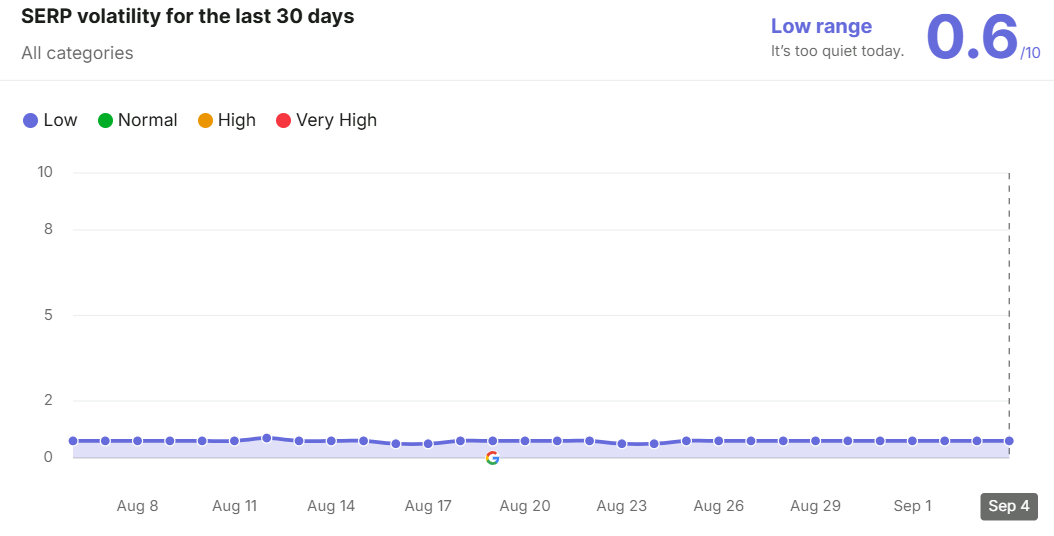
If your website has been hit by this update, consult Google’s spam policy guidelines. Try to figure out which policy or policies your website is at odds with, resolve the issues, then wait for recovery to begin.
Be aware that it can take months. Google needs to see evidence of improvement over an extended period of time, so patience is important.
We cover this update in detail in our live guide to Google’s major updates.
🔴 Cloudflare misconfigurations are harming website SEO
In our July roundup, we discussed Cloudflare’s new bot access controls and how they give websites a more nuanced way to manage which bots can access which content and how they can use it.
This is broadly good news, but with such a wealth of options now available, it’s all too easy to make a mistake and accidentally block Googlebot (or other search engines) from crawling your site.
This would lead to your traffic decreasing rapidly.
While not an entirely new issue, some SEOs are noticing it happening specifically in relation to Cloudflare’s controls.
For website owners…
It’s essential that whoever manages or has access to these controls truly understands them and their implications for SEO.
🟡 Google’s method of reading structured data has changed
Google is becoming less forgiving of incorrectly formatted schema markup. Previously, its crawler could sometimes fix certain encoding errors automatically; now, the structured data needs to follow standard JSON formatting to be read correctly.
For site owners…
Sites using correctly formatted JSON shouldn't need to make changes. However, implementations that have relied on Google correcting double-escaped HTML entities could see certain structured-data properties stop being interpreted as intended, potentially affecting eligibility for relevant Rich Results.
It's therefore worth checking custom or complex JSON-LD implementations and validating affected pages. If you need support with this, TDMP can help. Structured data implementation is central to our technical optimisation process. Learn more about our SEO services.
🟡 Google rolls out intermediary ‘goto’ link
In what could be an effort to prevent third parties from scraping their search results, Google is rolling out an intermediary link between the blue links on its SERPs and the actual websites they lead to.
For example, normally a search result contains a fairly direct link to the destination:
google.com → yoursite.com/page
With the new setup, Google can instead put a Google URL behind the result:
google.com → google.com/goto/... → yoursite.com/page
For site owners…
The change could make life harder for third-party SEO tools that monitor Google's search results. Because result links are being routed through Google's own google.com/goto URLs, tools may have to do more work to identify the underlying destination URLs. That could affect how some platforms collect or report ranking and SERP data, although the tools are likely to adapt.
Note, this will not impact any Google-owned properties, such as GA4. Your Google analytics should be unchanged by this update.
🟡 Google tweaks AI Overviews to increase AI Mode use
You may have noticed when searching on Google recently that, for some queries, you no longer have to click the ‘Show more’ button to expand the AI Overview. Instead, the full AI Overview may be present from the outset, concluding with the ‘Ask anything’ field that automatically redirects you to AI Mode.
A Google spokesperson has stated this happens ‘where our systems determine it’s most useful for people.’
For site owners…
With a pre-expanded AI Overview at position 0, organic results are pushed even further down the search results page. This means traditional rank, while still important, is not what it was. What’s more, the upward zero-click search trend will likely continue.
Thankfully, Google’s current citation approach in AI Overviews is quite publisher-friendly, but unless you’re in the mix, you’re reliant on the user scrolling down to your blue link listing.
This makes it all the more important to think about how AI visibility fits into your digital strategy - and TDMP can help you do it. We take a Search Everywhere Optimisation approach, applying strategies that support visibility wherever and however search happens. Request a free SEO audit.
🟢 Google AI Overviews still citing self-serving listicles
Self-serving listicles - where a business positions itself or its own products/services as the top options (or one of) - were a popular technique among certain publishers for boosting mentions in AI search.
For example, imagine TDMP published a blog post listing 'the best digital marketing agencies in the Midlands', then ranked ourselves as the best of the bunch.
These listicles were used to essentially trick AI into promoting a business or its offering over competitors.
Based on performance observations of these types of pages, it’s thought that Google took action against this technique a few months back. Many lost organic visibility, fast!
However, in some cases, Google’s AI Overviews still appear to be using them as a key resource when forming outputs and making recommendations for local queries.
Joy Jawkins took to X to post a screenshot of the problem (see below). Every recommendation cites a single lawyer’s self-serving listicle.
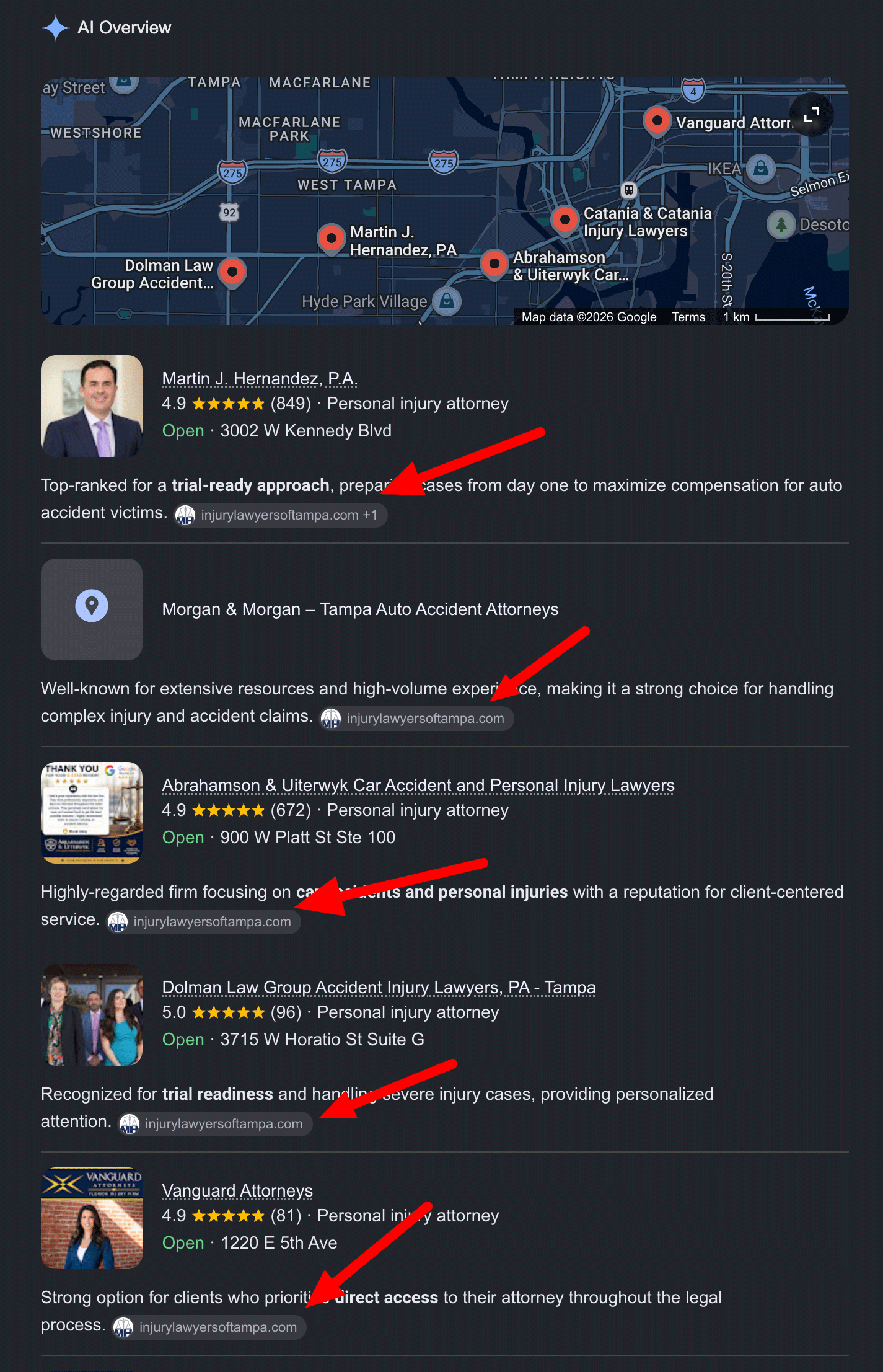
Source: X
The reason Google’s AI is drawn to this type of manipulative content is that it does appear to be the most direct answer to a user’s query.
Let’s say someone searched for “best digital marketing agencies in Derby”. If TDMP had a listicle that discussed all the digital marketing agencies in the area, but all the other agencies only had content about themselves, our content would seem like the most relevant material.
For businesses…
There are a lot of AI visibility techniques emerging, and many of them are either ineffective or unsustainable.
Markdown for AI crawlability is an example of the former, while self-serving listicles are a perfect example of the latter.
While they do still appear on occasion to be effective, we highly recommend against them for the following reasons:
- It’s a black hat technique: Self-serving listicles are a clear-cut case of black hat optimisation, meaning they’re designed to manipulate search results rather than earn visibility through meaningful improvements and value.
- It won’t last: Black hat gains are short-lived because Google is constantly updating its algorithms to filter manipulative content from its search results.
- It’s bad for UX: A self-serving listicle is the last place you want your human visitors to end up. These pages are clearly created in bad faith and depict you as untrustworthy.
One would also assume that filtering this kind of content out of AI Overviews would be a relatively easy job for Google. So we expect a resolution sooner rather than later.
To learn more about what we do recommend for AI visibility, see our recent update: AI visibility - What’s changed and what we’re doing about it
🟢 Google no longer enforces manual actions for site reputation abuse in the EEA
Google has announced that it will no longer enforce manual actions for site reputation abuse in the European Economic Area (EEA). This decision follows the European Commission’s concern that this spam policy restricts publishers' ability to conduct legitimate business and work with third parties.
Site reputation abuse is when third-party content is published on a better-performing website to give the content in question an unearned ranking boost.
Site owners with pages flagged for site reputation abuse will still receive a manual action notification in Search Console, but it will not result in any ranking penalties if a search is carried out by a user in an EEA territory.
Important to note is that this is a regional difference to search results, not a full exemption for sites with audiences within the EEA. That same flagged page will be penalised in search results outside of the EAA.
For example, if a UK publisher has a third-party commercial section on its site that receives a site reputation abuse manual action, that action could still suppress the affected pages when someone searches from the UK or the US.
But if someone searches for the same page from, say, France or Sweden, the manual action would not affect the search results. Google may instead treat the affected section as separate from the main site and allow it to rank independently over time.
This is the first time Google is applying different spam standards based on the location of a searcher.
🟢 Meta allegedly developing their own search engine
Apparent leaks from within the Meta team suggest that the company could be working on building their own search engine.
According to the Pieter Levels X post that broke this news, Meta’s goal is to prevent their AI from using Google Search because Google could then use the data from that search to train its own systems.
So, it’s unlikely to be a traditional public-facing search engine like Google or Bing, but rather a dedicated index for Meta’s AI.
Paid Media
🔴 Google Ads security feature limits actions based on user email address
With Google Ads accounts facing increasing security risks, Google is testing a new security feature that blocks users with non-corporate email addresses from taking “sensitive actions”.
For example, if someone on your team accesses your Google Ads account using an @gmail, or @outlook email address, they will not be able to complete certain actions. As for what constitutes a sensitive action, Google gave the following examples:
- Account linking updates
- User access changes
However, Google also mentions that the examples are non-exhaustive and subject to change without notice.
This feature is in a limited testing phase currently, for a 'subset of advertisers'. You can read Google’s own overview of the feature in this help document.
For advertisers…
You should receive an email notification if your account has been selected to pilot this prospective security feature.
If you’re one of the chosen few, we recommend sharing the news with anyone who operates at any level in your Google Ads account to avoid confusion.
Those with standard, free email domains will still be able to view reports and make basic campaign edits. But more sensitive actions will trigger a prompt advising to switch to an authorised corporate email to complete the task.
And should these users switch to a corporate address to bypass the limitations, it may trigger Multi-Party Approval (MPA) - another new(ish) security feature. If this is the case, you and another administrator will have to approve the new corporate email address.
🟡 Google Ads migrates more campaigns to AI Max
If you’re running campaigns using the automatically created assets (ACA) or campaign-level broad match settings, as of September 1st, they should now have been automatically transitioned into AI Max.
Google will have tried to mirror your pre-migration settings, which means:
- For ACA campaigns: Your AI Max campaign will have both search term matching and text customisation enabled.
- For campaign-level broad match: Your AI Max campaign will have only search term matching enabled.
These are the defaults - you can adjust them manually as you see fit.
🟡 Microsoft Advertising AI Max rolls out globally
Following an introductory announcement in April and a short pilot testing period in May, AI Max for Microsoft Advertising campaigns has now rolled out globally.
AI Max adds more automation to Microsoft Advertising’s Search campaigns, using AI to help advertisers find relevant searches beyond their existing keywords, tailor ad copy and send users to the most relevant page on their website.
For advertisers…
As with Google’s AI-powered campaign tools, advertisers may want to avoid a completely hands-off approach.
AI can expand reach, but it’s still worth monitoring where ads appear, which landing pages are being used and whether the additional traffic is genuinely valuable.
Stay current with TDMP
If you need support navigating any of the search updates discussed here, from managing bot access in an SEO-friendly way to ensuring your paid media accounts are effective as campaigns are migrated, TDMP can help. Let’s talk.
Explore our previous 2026 roundups: