

The Paid Media space has been relatively quiet so far this month, but SEO developments are coming thick and fast, including a Google pilot for paying publishers when their content is used in AI search features, and an entirely new Google ranking system in the works.
Updates are colour coded by importance:
🔴 Major developments likely to impact strategy
🟡 Worth watching or understanding
🟢 Informative - but lower impact for most
SEO
🔴 Google testing paying publishers for using content in AI search features
Google has launched what it’s calling the “AI Contribution Pilot” through which it will test paying websites when their content is used to form responses in Gemini, AI Overviews, and AI Mode.
It’s a small experiment, but those taking part have reported that it’s been a genuinely collaborative process so far. That said, some publisher executives involved noted that it would be better if Google was more forthcoming with the details of the payment system itself.
In part, Google’s lack of transparency likely comes down to rapid iteration. If they’re testing a variety of different approaches quickly, it might not be feasible to keep everyone involved in the loop.
According to Digiday, which reported on the pilot,
‘Google is likely still trying to figure out how to determine the value each piece of content has for its AI-generated responses, and that’s a complicated equation no one in the industry has yet figured out.’
What is clear is that payments would be made via Search Console - and only when content actually shapes the summarised answer. Pages cited for further reference, for example, would not trigger a payment.
For website owners…
Small but promising beginnings. If this test goes well, you could be both visible in Google’s AI search features and earn a fee for your content being instrumental in forming the response.
Would it have been good if Google worked on a payment system ready for the launch of AI Overviews? Yes. But better late than never.
🟡 Google is testing an LLM-based ranking system
Google’s DeepMind team has been working on a new type of ranking system for search.
The current system is a two-stage process:
- Dual Encoder stage - converts both queries and “documents” [read: content] into vectors to quickly retrieve pages that are likely to be relevant. This stage is quick and inexpensive.
- Cross Encoder stage - Reviews the pages recommended during the first stage and ranks them. This stage is slower and computationally expensive.
The work-in-progress system DeepMind is testing scraps the two-stage process for a unified, fully LLM-based approach they’re calling Autoregressive Ranking (ARR).
Based on recent tests discussed in DeepMind’s research paper, Bridging the Gap Between Dual and Cross Encoders, the current thinking seems to be that ARR has the foundational elements to be a more effective search system, but it’s not ready yet.
By “effective”, we mean it produces more relevant results for the user while increasing computational efficiency for Google (in terms of cost) and the user (in terms of speed).
For website owners…
Firstly, ARR is by no means ready to take over as Google’s ranking system. It’s not something you need to adapt to right now.
Secondly, although ARR would have an impact on SEO, it probably wouldn’t be a complete overhaul. Really, it’s just pushing further in the direction we’re already headed:
- Keywords will matter less: In theory, ARR will move Google even further away from keywords as relevance indicators. Instead, it understands the overall context of a piece of content, then uses that deep understanding to gauge relevance to queries.
- Why this isn’t new: Today's systems only rely partly on vector keyword matching to shortlist candidate pages.
- Entity clarity would be important: Because ARR relies on an LLM's internal representation of the web, unambiguous brand naming, clear schema, and consistent entity references across the web will help the model recognise your site as an authority.
- Why this isn’t new: Entity clarity is already a staple of our Search Everywhere Optimisation strategy, particularly for supporting visibility in AI search. Learn more in our guide: AI visibility - What’s changed and what we’re doing about it
ARR might also be better than Dual Encoding at finding details in long-form content, so your comprehensive deep dives may actually gain some additional visibility for niche, long-tail queries.
🟡 Google begins rolling out “Tell Maps”
Back in April, we covered Google’s US and India Ask Maps launch, a feature designed to help users plan their activities and trips directly within Maps.
Following some light agentic upgrades to Ask Maps and an expansion to several other nations (but not the UK), Google has launched Tell Maps, a similar interactive experience but specifically for Maps contributors.
Instead of manually posting an update, contributors can ‘suggest updates conversationally’ using the ‘Contribute’ tab in Ask Maps. You can also upload images, and Tell Maps is able to apply details from the image and post updates accordingly.
As an example, Google says that you can:
‘... upload a photo of a storefront sign [and] Maps will detect the new hours from the image, and ask to confirm before submitting the suggestion for you.’
Google also mentioned that contributors can pass Tell Maps ‘insider tips’. For example, a contributor might say that there is a free car park down the road from an establishment, and then Ask Maps will surface the advice to other users.
For local-facing businesses…
While Ask Maps and Tell Maps have yet to roll out in the UK, the implications for local search could be significant.
If multiple contributors tell Maps that "there’s plenty of free parking around the back" or "it's quiet enough to take a video call," Gemini may use those contextual details to inform local and AI search results.
This could be really helpful, providing a boost for relevant queries with local-intent.
Unsurprisingly though, it raises concerns regarding bad-faith contributions and sabotage. What if, for example, competitors use coordinated accounts to submit inaccurate details - such as false claims about cash-only payments or incorrect entrance locations - and you were unaware?
These are valid concerns, but Google has been developing systems to keep fake Maps contributions at bay for years. Tell Maps may make it easier for people to contribute, but the core system isn’t really changing, meaning there will be an established spam mitigation framework to keep data accurate.
So, while we advise businesses to stay vigilant with local reputation monitoring, especially at this early stage, Tell Maps won’t be lawless. There will be systems in place to ensure local profiles have some form of protection against casual sabotage.
🟢 Google Analytics bug showing zero traffic
On September 1st, a bug in Google Analytics caused GA4 to show a drop to zero web traffic on the main performance chart.
For website owners…
It’s alarming to see such a nose dive in your analytics, but there’s nothing to worry about. It is not reflective of your actual website performance. The bug was widely reported.
🟢 Bug removes links from Google Gemini Flash 3.8 answers
On September 2nd, Gemini 3.8 Flash rolled out in AI Mode for Google AI Pro and Ultra subscribers globally - and early users flagged a big problem.
In several examples posted to socials, Gemini 3.8 Flash responses to top-of-funnel queries showed zero website links or citations, a significant step back from the previous model.
Related - The UK’s 2026 zero click problem: what’s driving it and how businesses can respond
Glenn Gabe posted the following example to X:
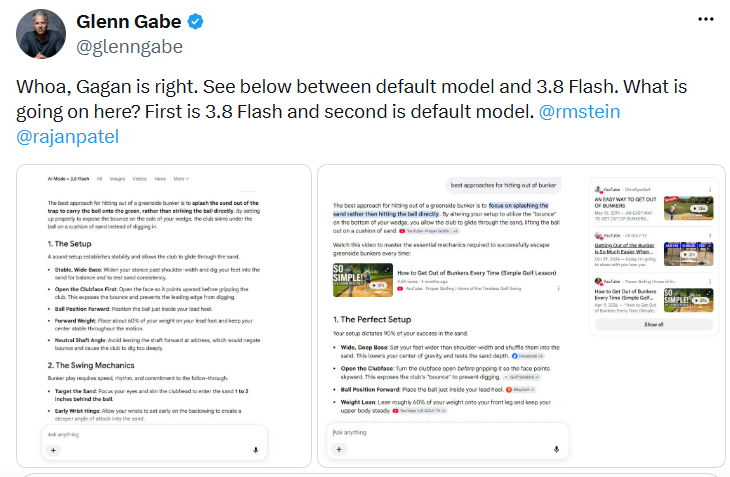
Source: X
Thankfully, Googlers were quick to respond, reassuring that Gemini 3.8 Flash wasn’t ‘working as intended.’
A fix has now been applied, and linking is comparable to the previous model.
Paid Media
🟡 AI dashboards rolling out in Google Ads
New AI dashboards have started to appear in some Google Ads accounts. They bring several new functions to the table, but perhaps the headline capability is that it can produce data visualisations based on text prompts.
For advertisers…
This is going to remove certain manual reporting tasks from your workflow. It should therefore make it much easier to communicate progress to senior stakeholders and sustain support and investment.
This does mean, however, as a baseline, you have to know what you need from your raw data. Otherwise, you won’t be able to explain clearly to Google’s AI what it should be doing. TDMP can help you make the most of these new dashboards when they’re available in your account. Learn more about our PPC services.
Stay current with TDMP
If you need help navigating any of the developments discussed in this roundup, or would like support in another area of digital marketing, TDMP can help. We adapt our digital strategies to deliver client success even as the search landscape shifts. Let’s talk.
Explore our previous 2026 roundups: